This post follows the Friends and volunteers on their activities, and new adventures from July through to September 2025.
It has been a busy time, with our regular volunteers attending and assisting a wide range of events and joining with others to support and celebrate our local heritage.
March arrived, and Springtime had definitely landed with bulbs flowering, and sunshine blazing down on a small band of regular volunteers arriving on site to get busy in the garden.
Unfriendly weather, but not entirely dull. No sign of summer sun. June was the summer-free month, uninterrupted by good weather. Volunteers were on site sporadically throughout, on the 1st, 8th, 22nd and 29th June. Inbetween them came rain and cloud. Frequently. Unreasonably unseasonal weather kept us away, and yet it proved to be a very memorable month as you will read.
In this special Anniversary post, Chair of the Friends of Hemingfield Colliery, Steve Grudgings shares the first selection of reflections on a decade of challenges, progress and change at Hemingfield.
Celebrating 10 years of the Friends of Hemingfield CollieryContinue reading →
Dead Chillness reigns. And yet my heart would say – “Winter! I love thee well.” Though birds forlorn Send no glad anthem from the snowy spray, Yet gushing melodies are hither borne From infant Dearne. Drear in the early morn Ye seem, wild Alpine woods! – that guard this child Of moorland springs, – ye summer-green, all torn; Yet, Winter gives a garment undefiled Of snowflakes light. Joy now the day-beam brings, And sun-tipp’d gems light up the frozen wild…
Thomas Lister, ‘Winter Scene [In the wooded valley below Dearne Spring]’, from The Yorkshire Magazine, Vol.I, no.IV, January 1872, p.121
It was a sunny, soaking and an especially busy September for the Friends of Hemingfield Colliery. This month always brings the exciting prospect of Heritage Open Days, when we open up our site for a longer period, with our dedicated volunteers providing tours and sharing their enthusiasm for the site, its history and the plans for future developments. It’s also still very much a working month, with the last un-wintry weekends keeping hands-on repair projects moving.
Wall work
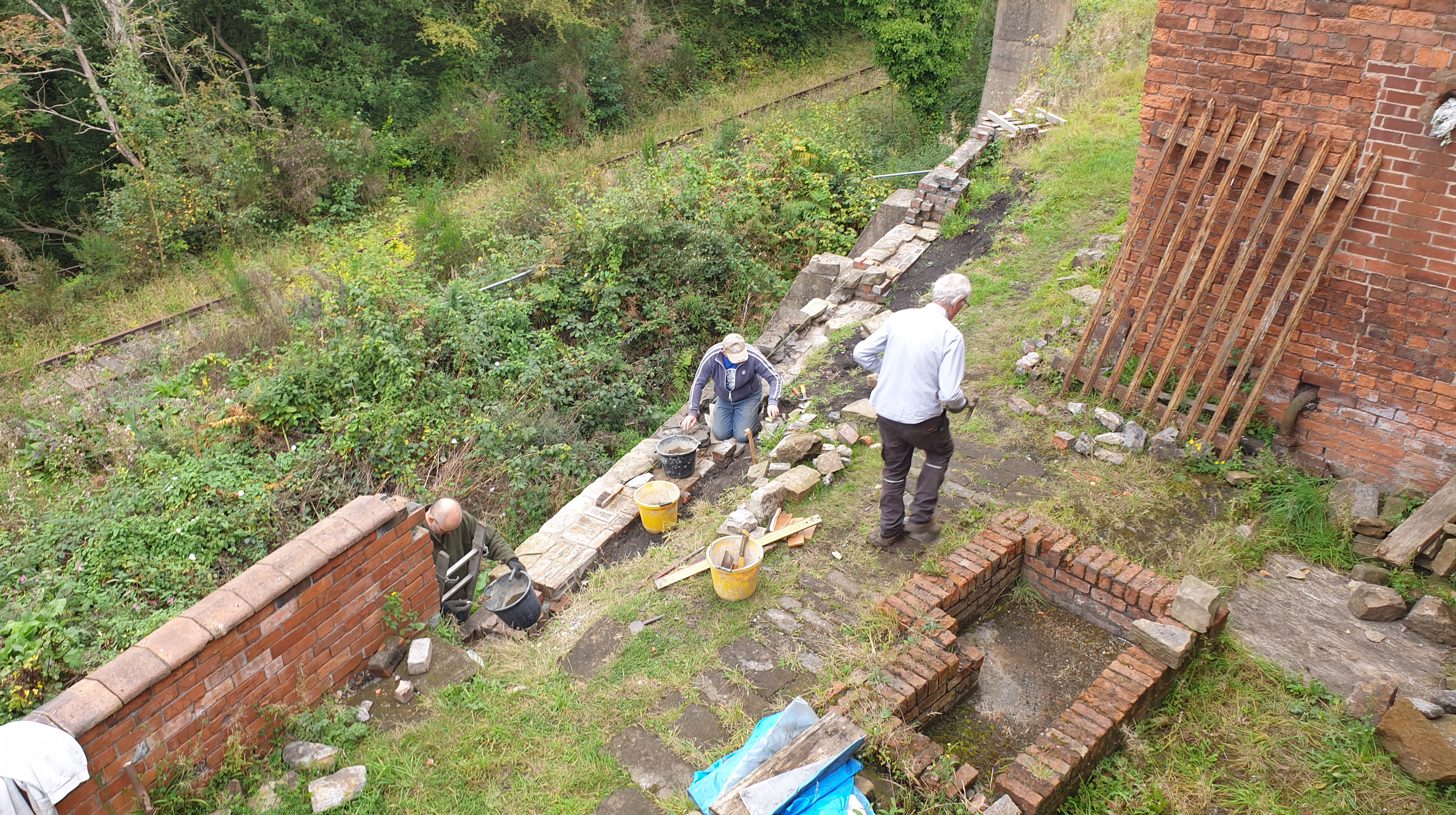
A good example of this is the ongoing large-scale effort to repair and consolidate the rear retaining wall. John, Paul, Jamie, Paul, and Jeff have been combining efforts when on site to push this forward.
Trio of happy wall workers, 16th Sept 2023
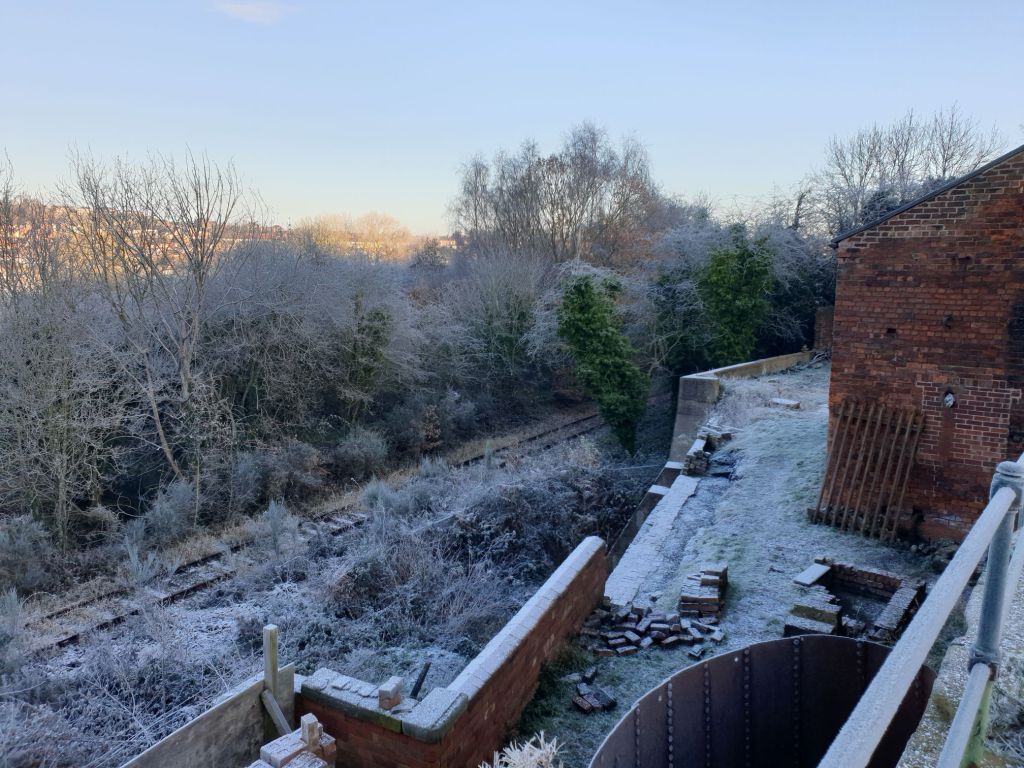
Having made significant progress in repairing the face and base of the masonry over the last 2 years, the main focus recently has been on tying the wall more firmly into the rear terrace and providing a more substantial footing at the top to enable us to rebuild the collapsed brick wall which once lined the top.
Wall work, 9th Sept 2023
When completed this work will allow us to tidy up the rear of the site, improving security, safety for visitors, and opening up more of the lower terrace. Advancing this work also means further restoration activities (of which there are no shortage) can be planned, freeing volunteer efforts to be directed elsewhere.
Rear wall, 16th Sept 2023
Good progress on rear wall, 30th Sept 2023
Wedge issues
On 11th September 2023, a team from Barnsley Council kindly answered a concerned call to address a safety issue caused by a tree growing between a telegraph pole and the pit’s front wall. The problem tree has been doing significant damage to the pit’s boundary wall, and also lifting the surface of the public pavement outside. Years of growth were pushing our wall over, but also causing the telegraph post to lean ever-closer towards Pit Row with slack wires hanging ever-lower. Having checked the tree’s status, and in the interests of safety and protecting our heritage, this large tree was taken down.
Photo-collage of safe removal of tree which had grown on pavement between the wall and telegraph post, causing damage to all three until 11th Sept 2023.
Making short and smart work of the job, the tree was removed, the Friends allowing site access for the tree to fall, away from the road, thus avoiding a road closure.
Gone! Cracked pavement, levered wall and telegraph post, with the tree stump cut for safety, 16th Sept 2023
The front wall, part of the scheduled monument, has suffered from the tree’s growth, wedged as it was between the telegraph post and wall. The wall itself has also been subject to years of vandalism, with graffiti and some rather more recent criminal damage, all of which creates challenges for the Friends as a volunteer organisation to try to fix.
Leaning pole of Pit Row, wider view, 16th Sept 2023
Heritage Open Days
On to Heritage Open Days (HODs). The theme for 2023 was “Creativity Unwrapped” – the perfect opportunity to share our new exhibition in Pump House Cottage.
Heritage Open Day, 17th Sept 2023
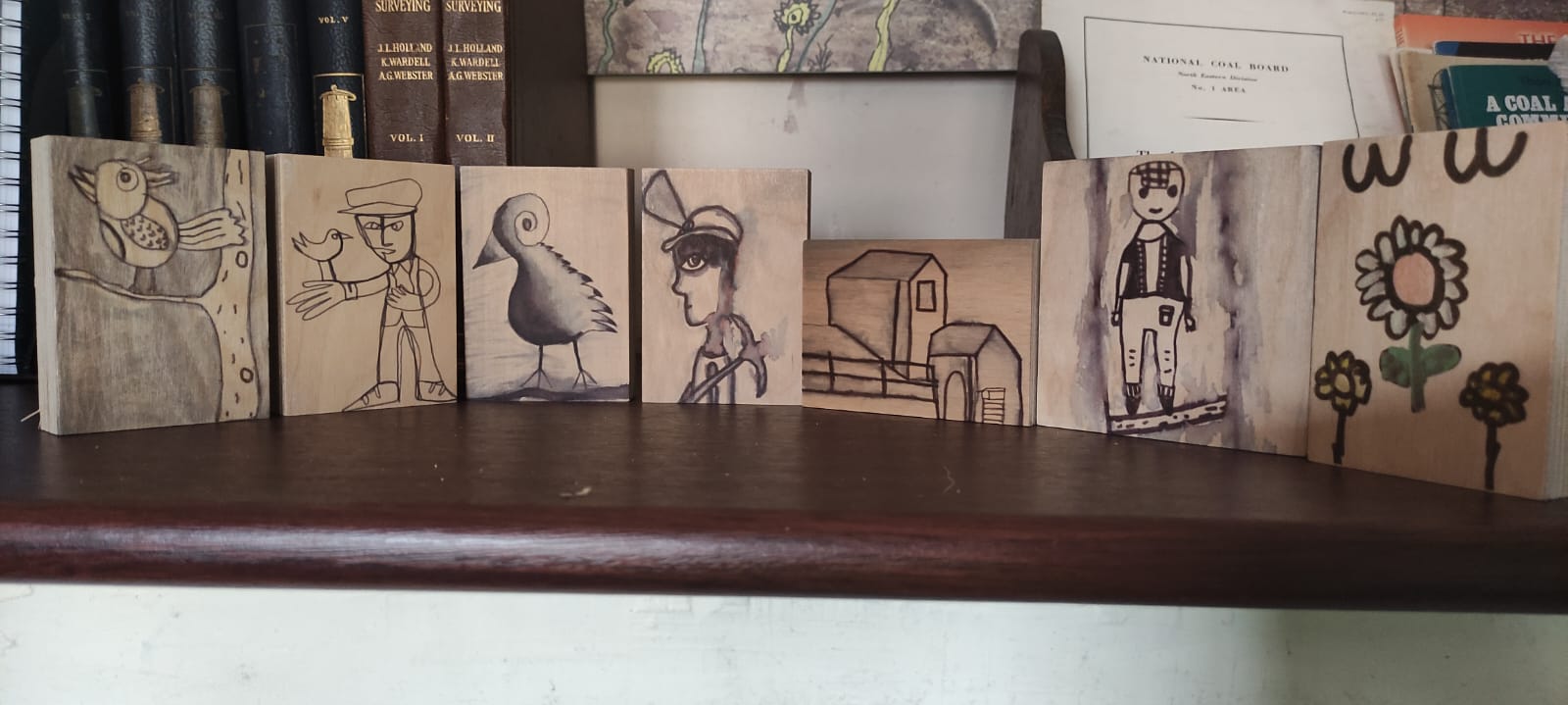
Celebrating the closure of our National Lottery Heritage Fund Project, Hemingfield’s Hidden History, the exhibition shows the results of the creative work artist Fabric Lenny undertook with local primary school children from Hemingfield Ellis.
Detail of exhibition, 9th Sept 2023
Inspired by the heritage and biodiversity found all around our site, the colourful artworks were compiled into a large final piece which is now permanently mounted on the wall of Pump House Cottage.
Exhibition of Hemingfield Ellis Primary School artwork, 9th Sept 2023
Over two wonderful weekends the Friends welcomed over 100 visitors to the site for the Heritage Open Days.
Exhibition art, 9th Sept 2023
Starting with a surprisingly hot Saturday, and a slightly darker Sunday, we were pleased to show lots of new visitors around the site, and to share some of the outcomes of our recent work in and around Pump House Cottage, and around the back.
Pump House Cottage garden, 17th Sept 2023
With our new guidebook and a selection of new and secondhand books and postcards, we were also grateful to receive several contributions, and were blown away by the final weekend, which saw the highest number of visitors yet recorded.
A HUGE thank you to all visitors, but especially to our regular volunteers who pulled out all the stops.
Green to Grey
The rest of the month was a chance to wind down a little bit, and reflect on the HODs activities whilst continuing regular maintenance duties.
Grey day, 30th Sept 2023
Grey skies dominated, but there was no shortage of colour at ground level; from the late flowers in Pump House Cottage garden, to the first orange-brown leaves swept up outside.
Autumn in the air? Leaf harvest from front of pit, 30th Sept 2023
Who predicts a riot? Elsecar in 1893
130 years ago, in 1893, a serious national industrial dispute took place between colliery owners and working miners in union districts affiliated with the Miners’ Federation of Great Britain. Lasting many weeks from June until November 1893, the dispute was, ostensibly, fought over the employers’ demand to reduce wages at a time of much lower coal prices.
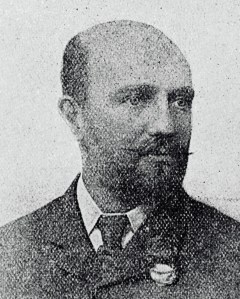
Portrait of Arthur Marshall Chambers (18 -1899), Managing Director of Newton, Chambers & Co. Ltd, and President of the Coalowners Federation, from: Percy, C.M., Mining in the Victorian era: a popular record of coal mining progress from 1837 to 1897, Wigan: Wall and Sons, p.66
Arthur Marshall Chambers, the Managing Director of Newton, Chambers Co Ltd, at Thorncliffe, in Chapeltown, was the President of the Federated Coalowners who refused to maintain the same rate of wages, and decided to lock out workers and reduce output at their pits. collieries summarised their position:
Unless high prices can be obtained, high wages cannot be paid; and maintenance of high wages in times of depressed trade simply means reduced sales, less money for the workmen, and increased cost to the owners. If the owners in the Midland districts have to continue to pay the full 40 per cent. on the 1888 prices, the result will inevitably be that their pits will only work one or two days per week, which means an enormous loss to the owners, and would eventually cause the permanent stoppage of a large number of collieries.
Arthur Marshall Chambers, President of the Coalowners Federation, quoted in the Journal of Gas Lighting, Vol.LXII, No.1586, 3rd Oct 1893, p.636
Voices of dissent
Miners representatives held to a simpler line: no reductions, and solidarity of the district associations with the Federation. Ben Pickard, M.P., President of the Miners Federation, and on the executive of the Yorkshire Miners Association spoke plainly at a meeting in Barnsley.
Benjamin Pickard M.P., President of the Yorkshire Miners Association
…the whole of this business has been managed by those who have not merely brains – lawyers – but plenty of money, and if it is a question of the longest purse against an empty stomach, such coalowners must take the whole responsibility as to whether the workmen will submit to such demands and reductions in wages as are presented to them at the current time.”
Pickard speaking on Thurs 21 Sept 1893, published in Sheffield Telegraph, 22nd Sept 1893, p.5
Desperation
Groups of miners had been locked out of work. Some, after months of hardship, many were desperate, having to appeal for support from their own communities:
FRIENDS: - It is with feelings of the deepest regret that we are at present compelled, for the support of ourselves and families, to offer these few but simple verses to your notice, trusting you will be pleased to purchase this paper, it being the only means left us at present to support the tender thread of our existence, and to keep us and our families from the utter starvation which at present surrounds us.

We have entered in the battlefield,
The battle for to fight
Which our masters have compelled us,
But we do not think it right.
The public when they hear both sides,
Their opinions they can give,
I think that they will boldly say
That miners cannot live.

In eighteen hundred and ninety-three
Ready for the action,
Our masters without sympathy
Asked for a reduction.
[...]

(William Roberts, Miner of Platts Common,'Eighteen Hundred and Ninety Three or the Field of Battle'(fundraising poem during the Miners Lock-out. Hoyland Silkstone Branch)
As the weeks rolled by men and boys out of work grew more and more desperate, and some sought to lash out at colliery owners through direct and sometimes violent action. It was met by a heavy Police and even military response, most infamously at Featherstone on 7th Sept 1893, when two young miners, James Gibbs and James Duggan, were shot and killed.
Riot at Simon Wood Colliery
A day earlier, on 6th Sept 1893, an attack had also taken place at Elsecar, at Earl Fitzwilliam’s Simon Wood Colliery.
Detail from plan of the area around Simon Wood Colliery, c.1889 showing the bridge from the village side (Reform Row) over the canal to the pit head. Buildings including the lamp cabin can be seen. (Courtesy private collection)
A crowd of men, boys and women, some local, others travelling into the area, headed to Simon Wood pit intending to damage the colliery and preventing it for working. Initially a tiny group of 13 West Riding of Yorkshire Constabulary Policemen attempted to see off a crowd of around 200 people at 12:45pm, approaching the pit from the village side, opposite Reform Row, and attempting to get to the works via the footbridge over the canal.
…a severe hand-to-hand fight took place on the bridge which, being narrow, gave the police a great advantage over the mob who yelled and swore like demons, yet the police stuck to their duty and drove the mob off the premises to some yards distant and then wisely returned to the bridge. The mob came on again armed with stones and the police stood on the bridge. Stones came at them from the centre of the mob in showers. The mob made a second attack on the bridge but were again driven back by the Constables with batons. The mob then broke open the lamp room, carried out all the lamps (about 400) broke them against the building and threw them into the canal. They then turned on the oil taps and set fire to it when the police again charged the mob, used their batons freely, got possession of the lamp room and extinguished the fire.
Police Report on the Riot at Simon Wood Colliery, No. 7 Division Superintendent’s Office, Barnsley 3rd of October 1893
Following the riot, charges were brought against a small number of young men and several women:
On the 6th September, 1893 at Hoyland Nether, in the said West Riding of York, with divers other persons whose names are unknown, to the amount of 100 and upwards, then and there being riotously and tumultuously assembled together, to the disturbance of the public peace, feloniously did unlawfully, and with force, demolish a certain building, namely a lamp room, the property of the Right Hon. William Thomas Spencer, Earl Fitzwilliam, against the peace of our Sovereign Lady the Queen and contrary to the form of the statute in such case made and provided.”
Charge brought against local people at Barnsley Magistrates Court
National outrage
The Home Secretary, Herbert Asquith spoke out against the chaos in a debate in Parliament:
A very grave state of things existed in the West Riding of Yorkshire three weeks ago. I am not prepared, from the information I have received, to assent to the proposition that the riotous and marauding proceedings that went on, the wrecking of collieries, the burning down of buildings, the levying of toll on innocent passers by—that these actions met with any sympathy whatever from the general body of miners on strike. I believe these outrages were the work of a comparatively small number of rowdies and normally unoccupied men, and that, so far as the general opinion of the mining population was concerned, they would discountenance any such proceedings.
Herbert Asquith, Secretary of State for the Home Department, Hansard, House of Commons Debate 20th September 1893, vol 17 cc 1724-25
A Lord’s Lament
At Elsecar Earl Fitzwilliam advocated for direct negotiations with his workers, without union meddling:
Goodwill, peace, and prosperity prevailed at Stubbin and Elsecar. So far as I know, the workmen had no complaint against me. I certainly had none against them. Yet the men belonging to the Miners’ Federation were ordered out of the pits; those not belonging to the Federation dared not continue to work, or, in many cases, even to acknowledge they were not members of that Federation, and most reluctantly all were compelled to remain idle and see their families suffer. No commercial enterprise can prosper under such circumstances. If I opened my pits to-day, the men might be ordered out to-morrow, though both employers and employed wished to go on working peaceably and profitably. Grieved as I am to be obliged to say so, I fear I cannot reopen my pits until peace, security, and freedom of action are restored. Yours faithfully, Fitzwilliam.
Earl Fitzwilliam writing to William Marklew of Parkgate, 28th October 1893
Aftermath
The bitter struggle only drew to a conclusion when the Government stepped in and offered a Conciliation mechanism, and a return to work without pay cuts to satisfy the Miners Federation, for a short time at least. It was perhaps a phyrric victory, as Sheffield and Derbyshire Colliery proprietor Emerson Bainbridge put it in terms of pounds, shillings and pence:
“… it will be seen that the miners have deprived themselves, in the period of sixteen weeks during which they were on strike, of wages amounting to about £6,000,000 sterling, besides the loss of the Union funds which they had in hand. It will, therefore, be seen that, in order to resist what might have been a temporary reduction of wages of £2,000,000, the miners have themselves suffered a loss, up to date, of £6,000,000.”
Colliery proprietor and consulting engineer Emerson Bainbridge, writing on ‘The Coal Strike of 1893’, in Contemprary Review, Vol.LXV, January 1894, pp.1-15 (p.10)
Wet weather rained us off on 4th August, but the Friends picked up the pace during the month which was, traditionally, expected to be somewhat summery…
June. A beautiful time of year. The first steps of summer, without the school holidays. When the sun’s heat brings plants, people, and other wild-life out into the longer light of day.
Striking image of light and life at Hemingfield Colliery, June 2023 (Photo credit: Mitchell Sutherland)
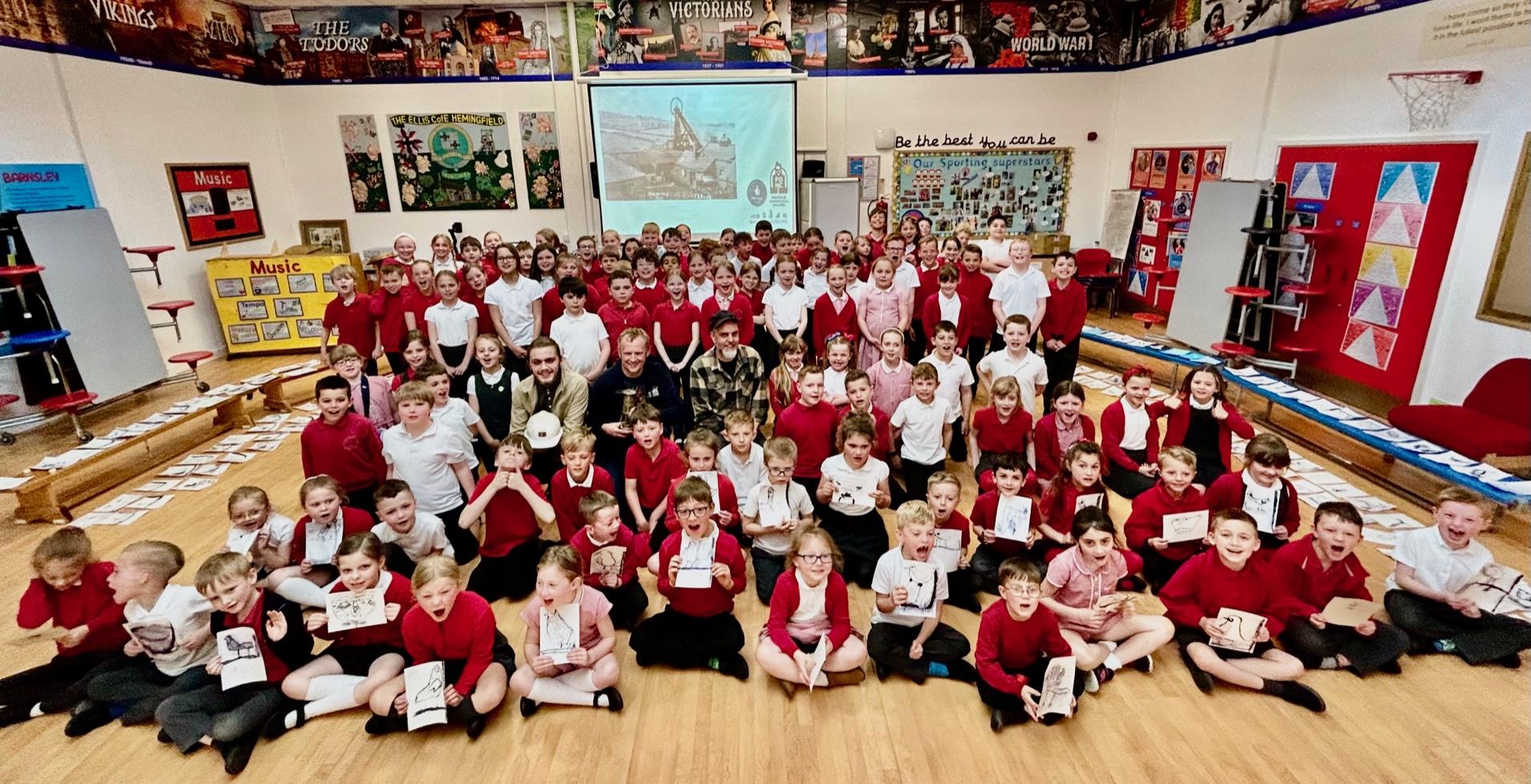
Assembly at Ellis Primary together with FoHC volunteer Mitchell Sutherland, artist Fabric Lenny, School Governor Mark Farnsworth and pupils surrounded by the fantastic artwork (Courtesy Barnsley Museums)
As part of the Friends of Hemingfield Colliery’s National Lottery Heritage Fund project Hemingfield’s Hidden History, the group organised a creative heritage activity at the Ellis primary school in Hemingfield village.
Thanks to National Lottery Players for helping to save and safeguard our industrial heritage and engage the next generation.














 Friends of Hemingfield Colliery