Brick by brick, late March 2025

Back at it, another brisk weekend on site on Saturday 22nd March 2025. Regular volunteers Janet and Jeff, Paul, Andy and Chris. Still in early days of the year, visits and events wise. So some maintenance jobs and chasing up plans for bigger repair efforts to come.

South Yorkshire’s Community Fund

All of which have been greatly assisted by the support of South Yorkshire’s Community Foundation through their grant towards our site insurance costs to undertake activities this year.


Hitting the garden in Pump House Cottage, Janet and Jeff are doing sterling work, weeding, cutting back, and tidying up the brick paths weathered over the winter.
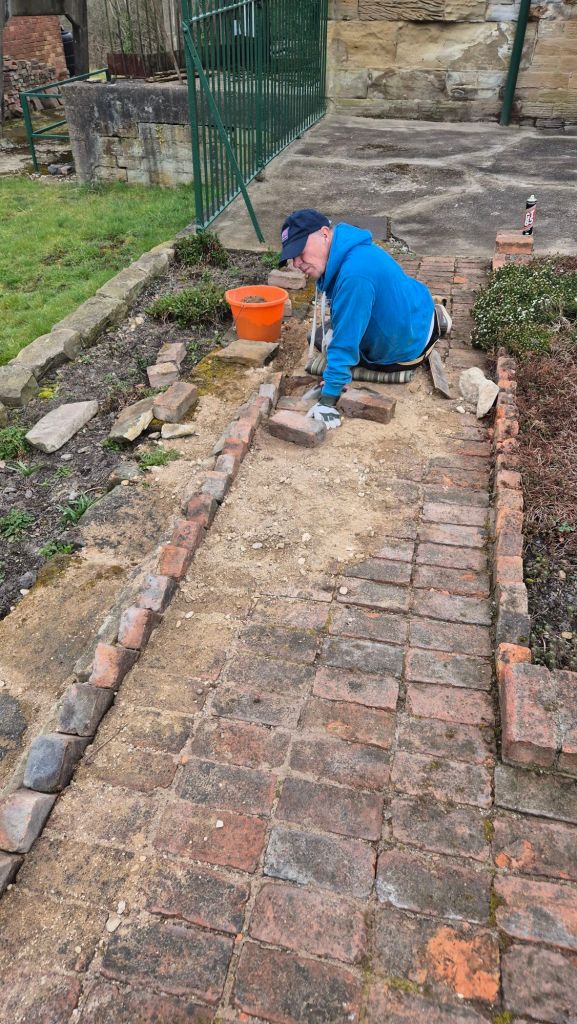
Jeff gets stuck in, repairing the garden path, 22nd March 2025

As well as replacing fractured bricks, Jeff started to reset the decorative edging of the path.
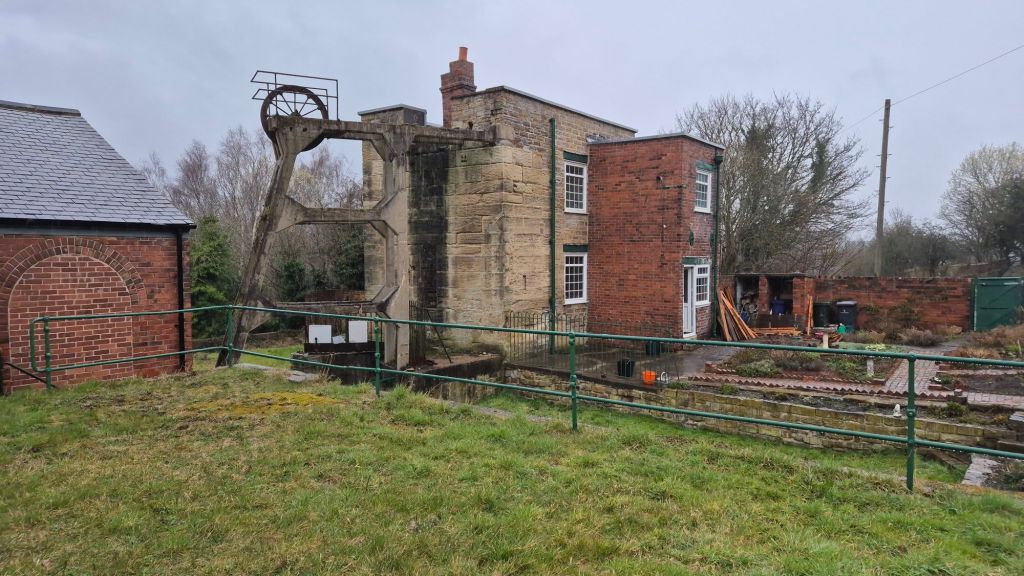
Some light rain later in the day brought dark clouds over Pump House Cottage.

Wonderwalls

It’s all about Bricks! Aside from sandstone, the main material visible at Hemingfield is definitely the humble brick. 19th and 20th Century examples abound. We certainly have many bricks, not all of them are in their rightful places – especially out front, in the boundary wall on Wath Road:

Wonky walls and the results of wilful damage, outside the pit, 22nd March 2025

What happened? Well, staying within the bounds of moderation, criminal damage happened. A significant chunk very likely by one individual, and mostly after 2019, but also other uninvited guests over time did not help matters.

Compare the above March 2025 image with this one below from August 2016:

View of front wall looking down Wath Road, 6th August 2016

This step back into the not-too-distant past shows quite a contrast in terms of showing the loss in height of the wall:

View of much more complete front wall onto Wath Road, 6th August 2016

Can you help?

As for repairing/restoring the wall, we will need quite a lot of help! None of our excellent volunteers are qualified or experienced bricklayers. We have the materials and tools, but need to secure the expertise and permission to move forward.

Just another brick in the wall?

Looking along the top of the wonky wall, 22 March 2025

Before any work can begin, we are seeking to record the front wall construction to determine the appropriate methods and materials.

Brickbats and mortar
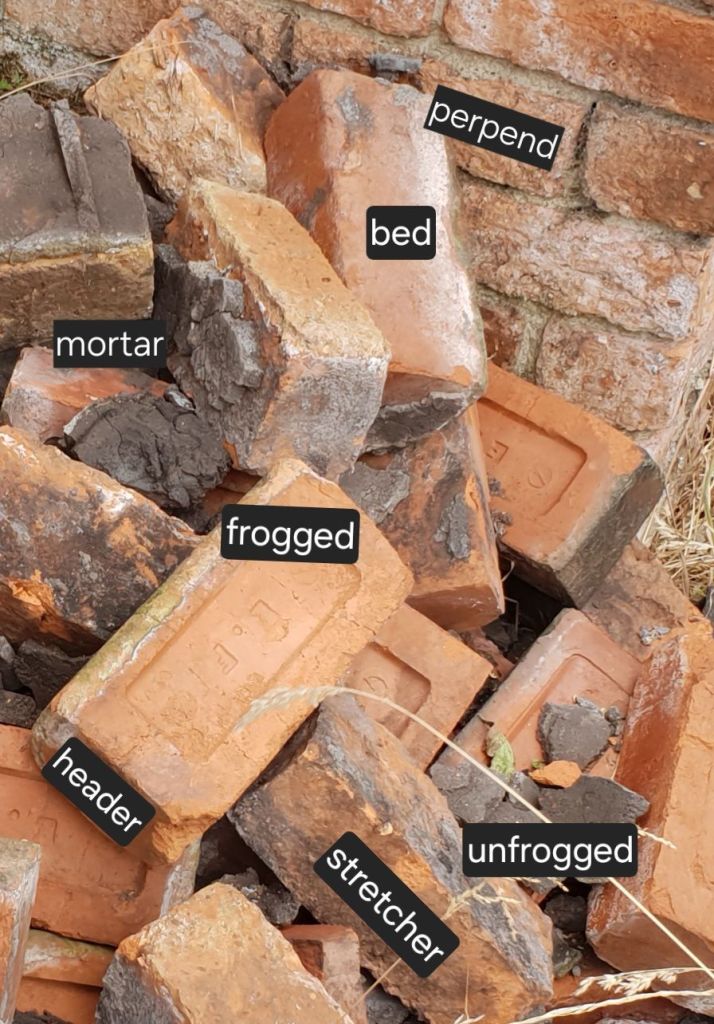
A tumbled, jumbled stack of bricks from the front wall, showing examples of brickwork terminology described below.

In most simple brick walls, the bricks are laid in rising rows (courses) of blocks, usually of the same standard size and colour. Each vertical stack of bricks in the depth of the wall is known as a wythe. Brickwork seen front-on shows different methods of bonding patterns in the courses, used for particular structural or decorative purposes, and generally consisting of headers (thin end of brick facing out) and stretchers (long side facing out).

The mortar holding them together usually sits on the top and bottom faces (beds), forming horizontal bed joints, whilst the mortar forming the vertical joints on each end forms what are known as perpends. From the 19th century many bricks are frogged, that is they have a depression in the top or bottom face (bed) to hold more mortar for adhesion, and which is also often used for advertising the brand of the brickmaker. Doubled frogged means the top and bottom both have this impression from the pressing of the original clay brick before it was fired.

Pointing refers to the use of mortar in connecting the bricks building the wall, its thickness, depth and material, e.g. lime mortar, cement mortar, with additives of various sorts reflecting local practice or just the immediate availability of materials.

In context

The surviving boundary wall at the Wath Road entrance can be seen as consisting of 6 sections:
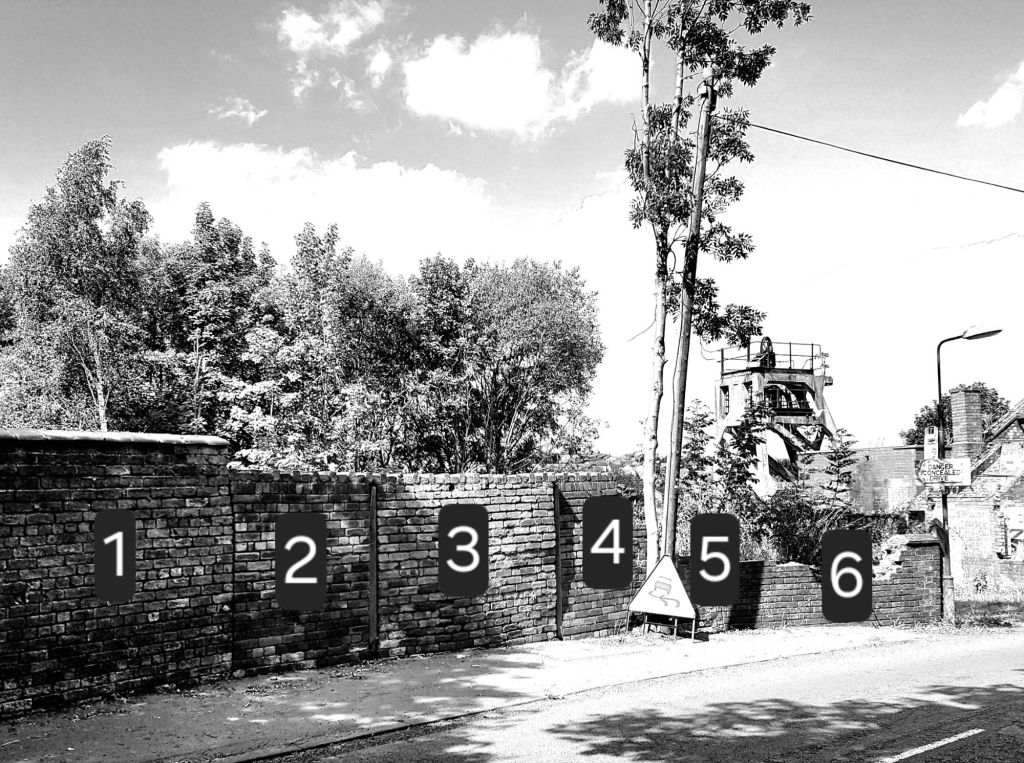
Black and white wall reference image from August 2016 when it was much less damaged than in March 2025

A brief look at each of these sections reveals some interesting insights into the history of the site throughout its pit and pumping station years, pre- and post- 1920.

  1. Solid and stable high wall, 24 visible courses high on Wath Road side. 1½ bricks deep, or 3  parallel stretchers, capped with Skiers Spring terra cotta tiles which were also used on the majority of the boundary wall until demolished and replaced in the 1990s. Generally Common English garden wall bonding, that is 3 courses of stretchers (side full length of brick) and one of headers (short top side of brick). Seemingly heightened at some stage and showing a mixture of mortars and at the rear a greater greater variety of darker pressed bricks.
  2. Butt joint with section 1. 22 courses high originally (up to 2019), 6 stretchers wide, 1 brick deep, with a top ‘castellation’ decoration which was continued across sections 2-4. Also has rear buttress after joint with section 1 which has an anchor plate and iron tie bar. Bonding is a variation of Common English garden wall bond at the bottom, then a space of 6 courses of stretchers and another of headers. Poor mortar mix and strength, explains the extent and relative ease of damage seen here, mortar possibly mixed with coal dust as a grit.
  3. Vertical timbers either end of section, 10 ½ stretchers wide. 1 brick deep. Top castellation’ decoration continued from section 2 into 4 over both timbers on a thin diminishing row left-to-right. Uneven pointing, and less care in bonding work than sections 1, 2, 4,or 6. Some noticeable bulging and lean.
  4. From the vertical timber of section 3, 22 courses high, 1 brick deep, now a leaning section due to the tree growth behind the telegraph pole, (similar to 5 into which it is badly bonded). Until more recent years this section included 2 step-downs in height to section 5, dropping 3 bricks, then 4 then 3 in height to meet section 5 at the height of section 6’s coping.
  5. Bonded joints with 4, at an offset angle behind the telegraph pole, noticeably paler brick.  Rear of wall shows evidence of rebuilding/repair. Movement in the section and sections 3-5 led to buttressing and seemingly repairs in the past exacerbated by tree and felling in 2023. Right-hand side ends in a butt joint to 6. This section marks the edge of where there used to be a separate building on site, facing the road, seen in early 1900s image of the pit.
  6. This section is about 17 stretchers wide, 1½ bricks deep, with bonding matching the wall on the opposite side of the gate post, and similar to section 1. In June 2009 it retained 6 stone coping pieces, but by September 2011 all bar one of these had been removed. The Friends took on the site in 2014.
Detail of c.1907 image of colliery showing section 6 at the right (wooden gatepost removed/concrete in use by 1952). The large double-doored entrance to another slate roofed building appears to occupy the space now taken up by sections 3-5 and may reuse some of materials.
Detail from 1970s image courtesy Alan Hill, showing wooden gates with concrete gate posts which may have dated to the 1950s (current gates are NCB tubular metal). Section 6 appears complete and section 5 appears much lighter brick patching up to meet section 4 and up to the height of sections 3-2. Note there is no telegraph pole on the road, but is one within the pit yard and old boundary wall (with gate) can be seen to the right of the switchgear building (fire damaged in 2008)

Pole position

The prime cause of problems for much of the wall at sections 4 & 5, even after vandalism, relates to the telegraph pole, or rather the tree which grew behind it, levering the wall and pole in opposite directions.

Front brick wall of pit, looking surprisingly complete, with tree behind the telegraph pole, between sections 4&5. Old lamppost can also be seen by the concrete gatepost, 28th November 2015

For many years the tree had been pushing the pole towards the road, creating significant ‘play’ in the pole (it would move if pushed), as well as noticeable sag in the drop line wires over to Pit Row cottages. It had also been weakening the boundary wall, pushing it backwards.

View down the Wath Road front wall, showing the angle of telegraph pole with sagging line and the width of trunk of the tree pushing the wall backwards, 12 March 2022

After 2014, as the Friends secured the site with steel fencing on the damaged wall and filled gaps with wooden fence panels, we were also attempting to prop and stay further movement.

Troublesome tree felled, 11 September 2023

This situation came to a partial end in September 2023 when the huge tree was professionally cut down, thanks to the crew from Barnsley Council. This task was difficult to do without causing further weakness and lean on the boundary wall, and required increased propping in the yard at sections 5 and 4 in particular.

Leaning and the lamppost

New massive light column, 21 December 2024

All of which brings us up to date. In December 2024, a new tall light column replaced the old smaller one by the concrete gate post, however this has negatively affected the surface run off when rain water runs off the road.

Front wall looking across from opposite side of Wath Road, 8th March 2025, showing leaning telegraph pole with A1024 sticker on the left, and new light column with bus stop sign on the right.

In March 2025, the telegraph pole itself came in for attention, being tested and marked with a A1024 defect label notice. But what does that mean? And what are all the labels and numbers on telegraph poles all about anyway?

Unwanted knowledge, or telegraph pole appreciation
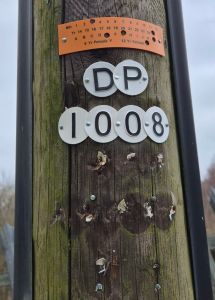
Telegraph pole close-up showing the DP number and latest test label, March 2025

Most active timber telegraph posts in the UK connecting to customers properties for telephone and data services via drop wires should have:

A) A designated number relative to the telephone exchange area (DP being a Distribution Point or pole, black letters on white plastic tiles), possibly fed from a nearby BT/PO/GPO footway cover box, otherwise it may just be a linking carrier post. Prior to plastic being used in 1963 numbers and letters were shown on enlarged metal nailheads or punched on metal strip.

Additional letters & numbers may appear below DP referring to a transposition code and serial number. This information used to be put c.8 feet high.

Other letters on their own, usually on coloured squared aluminium tiles 45mm x 45mm, which may alert visiting engineers to pole hazards and climbability, e.g. red D (Do not climb, use a MEWP – mobile elevating work platform or scaffold), there should be a red date label with the D; green C (Shallow Climable, with guidance), red SD (Shallow Depth pole), orange H (Hazard, within 1m for climbing, such as nearby spiked fencing, use MEWP) or green Z (Safe Climb Zone Pole, accredited climbers only or use a MEWP).

B) A plastic coloured test label (also known as a A558 label), in use since 1964. It consists of 3, or more likely 4, rows with punched holes recording the last test data:

1. A number to indicate the Month of the last major pole test. (Mth): 3= March

2. The Year of the pole test (Yr): 25 = 2025

3. Letter code – represent the pole tester who performed the test (thank you mystery tester!)

4. Two options on the next test cycle, 6 or Twelve years: 12 years.

We know ours was last tested in 2016, so it was less than 8 years since the last year.

Old pole test label (tested April 2016, in place until 2025)

Why the A1024 defect? Probably the wobble, or the slack dropwires.

Example of pole with blue A1024 defect label, here with reason of overloading of 17 d/w (dropwires) in 180 degrees at the top of the pole.

A further engineer visit appeared to add some stabilisation to the pole and tightened the dropwires, so no more defect.
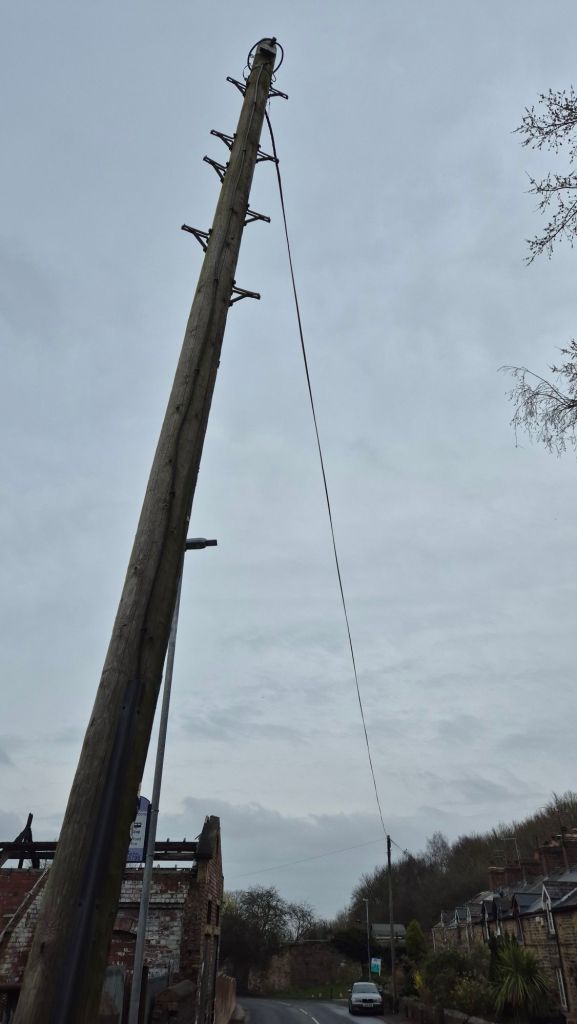
Newly taut dropwires from the stabilised and no longer defective pole, March 2025.

We haven’t mentioned the other BT labels seen, an A559 maximum pole loading label which should give a limit on the number of radial dropwire connections at the top of the pole. Also, at the foot of the pole – Openreach engineers may attach a pre-climb test label when they carry out an inspection and this level records the test date and serial number.

Cracking the code

The timber telegraph pole themselves usually have further markings (branding or impressions) reflecting their form, function and origin.

E.g.

Example of pole branding GPO/28M/57 denoting General Post Office pole, 28 foot, Medium, preserved in 1957

Depending on the age of the pole, the letters should be 10ft or 3 metres from the butt of the pole – which for modern poles should be 1.2 metres in the ground. A scored doby line may mark the 3 metre point, and a horizontal ground line may be visible at the rear of the pole. Additional marks on the butt of the pole would only be visible to depot and installation staff.

Ground line visible at rear of pole where the larger tree trunk had grown until 2023.

These denote:

  • Owner of the pole – GPO/PO/BT
  • Pole length and Class (feet for older and metres for newer poles  10 or 28 feet might be common examples. Classes include: XL = Extra Light, L = Light, M= Medium or  S = Stout
  • Year of preservation (timber treatment) e.g. 57, 97 not year of installation, but clearly it must be after this date.
  • Supplier mark and type of wood/preservation treatment – Not all poles of all ages show this, but as an example, 2I = supplier 2 and Imported I – if this info is missing, it is generally safe to assume the wood is Scots Pine and that it was creosoted through the Ruping process.

List of supplier/depot numbers and wood type codes:

Supplier depot codes

1 – James Jones (Supplied BT until 1998)
2Calders & Grandidge (1930s-current supplier)
3 – BBH (Burt, Boulton and Haywood, current, now Scanpole)
4 – PTG (supplied BT between 1997-2000 taken over by Scanpole)
5 – Scanpole (supplied BT 2000-2006)
6 – Scanpole (supplied BT 2000-2006)

Table of letter codes for types of wood, where no code perhaps safe to assume Scots Pine. Taken from Post Office Engineering Dept, Engineering Instructions. Lines Overhead, C.1101, issue 5, 22/4/1960. Courtesy Bob’s Telephone File.

Additional creosoting treatments may be recorded in further two year digits below the first. Pole re-use and shortening from the tip or the base may also lead to obliteration and new markings.

Our thanks to enthusiasts, General Post Office telephone engineers in years past, Robert Freshwater’s phenomenal Telephone File website and the Telegraph Pole Appreciation Society. You never know what you never wanted to know!

All creatures…

Pump House Cottage Garden, Saturday 15th March 2025 (Photo credit: Paul Moon)

Regular volunteers Paul, Janet & Jeff and Andy were on site on Saturday 15th March 2025. Thanks to support from South Yorkshire’s Community Foundation we can open the gates and operate on site with volunteers and members of the public. 

Spring time tidying was very much the order of the day, clearing the garden flower beds and paths of Pump House Cottage. So much for the flora. As for the fauna, scarcely a minute had passed on site before a kestrel was spotted high up on the main headgear.

Continue reading

Late great starts – February 2025

View of Hemingfield Colliery, Saturday 22nd February 2025

After several false starts due to the weather in January, and only the stoic efforts of our regular volunteer Paul braving the elements with several small groups up until now, regular volunteers finally returned to site on Saturday 22nd February 2025 to ‘begin’ the year. And what a lovely day!

Continue reading

2024 into 2025. Autumn Fantasia and the long winter.

2025 is here. There’s no denying. But the weather outside has been less-than-delightful, so we’re starting off by looking back – A more detailed catch-up from Autumn of 2024, with late touches of Winter frost which somewhat delayed the start of 2025.

But first, a great big thank you!

Getting festive with volunteers from the Friends of Hemingfield Colliery, 21st December 2024

To all our volunteers, visitors, supporters and friends. Without your support the Friends would not be able to keep doing their great work in maintaining and sharing the colliery site and its stories with the wider public.

Continue reading

Remembering the Oaks

The 12th December is a dark day in history for Barnsley. The catastrophic loss of life which occurred when there were a series of underground explosions at the Oaks Colliery, near Hoyle Mill.

View of Oaks Colliery at the time of the first explosion, published in the Penny Illustrated Paper, Vol.XI, No. 273, 22nd December 1866, p.397

On this day in 1866, 158 years ago, the first fateful explosion took place, to be compounded by a second explosion the following day as a search party explored the workings.

It was an event of regional, national and, indeed, international importance, with reporters being despatched from far and wide to report on a disaster the horrific nature and scale of which only became clearer over time.

Mr Montay, the London correspondent for the French newspaper Le Petit Journal set off for Barnsley by train on 14th December, arriving at the pit just before 1am on 15th December, he reported on a continuous procession of local people, miners, engineers, magistrates thronging the route to see if it was still possible to save a life, with thousands of people clamouring to learn the fate of the men underground.

Une procession continuelle, une longue file de paysans, de mineurs des pays voisins, d’ingénieurs, de magistrats encombraient la route.Tous tendaient au même but, tous allaient voir s’il n’y avait pas un-suprême effort à tenter pour sauver, ne fût-ce qu’une seule vie.

Le Petit Journal, Tues 18th December 1866, p.3

Others came to provide spiritual and emotional support, alongside local clergy including non-conformist preacher and friend of the poor from Rochdale, John Ashworth.

Ashworth’s short diary entries reveal in simple detail the shock and impact of the event:

Wednesday, Dec. 19. Visited the Oaks Colliery, scene of the explosion at Barnsley; conversed with Mrs Winter, Barker, and Cartwright; dreadful, dreadful, pit still burning, in which 300 persons are buried…

Thursday, Dec. 20. Felt very sad all day from the scenes of yesterday; the burning shaft is always before me…

Friday, Dec. 21. Received a letter from [James] Barker, Barnsley, giving particulars of his terrible search for his father and three brothers, after the explosion: all dead

Reproduced from Calman, A.L., Life and Labours of John Ashworth, Tubbs and Brook, Manchester, 1875, pp.120-121

He later wrote up his experiences in one of many collected short pieces published as Strange tales from humble life, entitled ‘Sad Story’ he described visiting the grieving families:

My next call was on the mother of James Barker ; the dear mother for whom he prayed when he found his three brothers amongst the dead. She resided at No. 3, Ash Row, Hoyle Mill. In this row of stone buildings, there are thirty dwellings, and, sad to relate, twenty-eight out of the thirty had one or more of the family amongst the dead. The angel of death had indeed visited these homes, and a great cry, like the cry of Egypt, had gone up to heaven. Groups of children, many of them too young to understand their loss, were playing about the doors.

‘A Sad Story’, Strange tales from humble life, 3rd Series, 1867, p.142

Investigation

Attending the subsequent Coroner’s Inquest at the time, Joseph Dickinson, a government Mines Inspector reported:

…the first explosion took place on the 12th of December, when 340 work-persons were employed in the colliery, of whom only six have survived the injuries, making the loss of life 334 by that day’s explosion. In addition to this, 27 persons, of whom four belonged to the colliery, and 23 who were volunteers, were killed by a succession of explosions (arising as it would appear from the pit having been set on fire by the first explosion), which commenced on the following morning whilst the workings were being explored for the purpose of rescuing any persons who might have survived and the
bodies of those who had perished.

Joseph Dickinson, writing from Pendleton, Manchester, 7th February 1867.

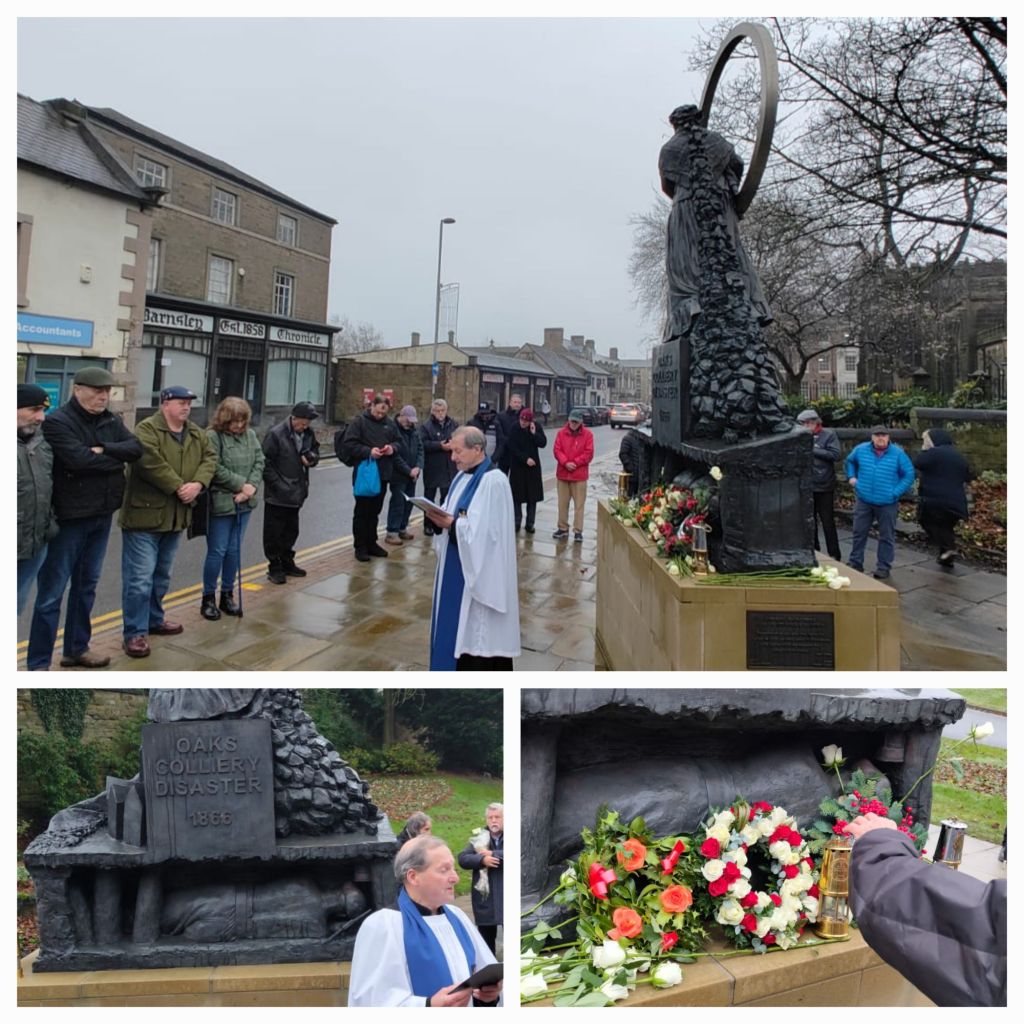
Returning to the present day, an outdoor service took place at the Oaks Colliery Disaster mining memorial sculpted by Graham Ibbeson, on Church Street in Barnsley town centre which was inaugurated in 2016.

Three photographs in a collage depicting the gathering of local people stood around the Oaks memorial in Barnsley for a commemorative service given by a minister for those who died in England's greatest colliery disaster in December 1866.
Photographic collage of memorial service in Barnsley, 12th December 2024 (Photo credit: Paul Moon)

The Friends of Hemingfield Colliery were pleased to attend the solemn and reflective service.

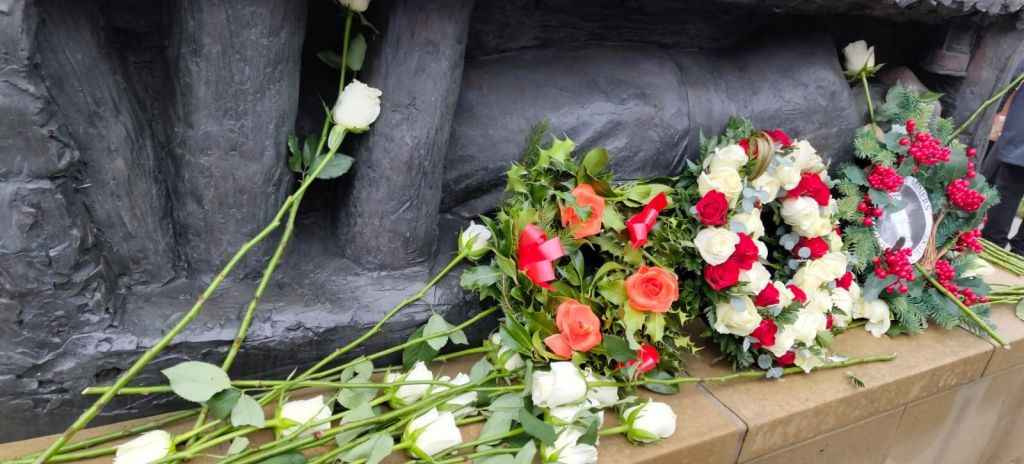
Flowers laid at the memorial

Attendees laid a white rose on the memorial in a poignant tribute to the lives lost so long ago. We will remember them.

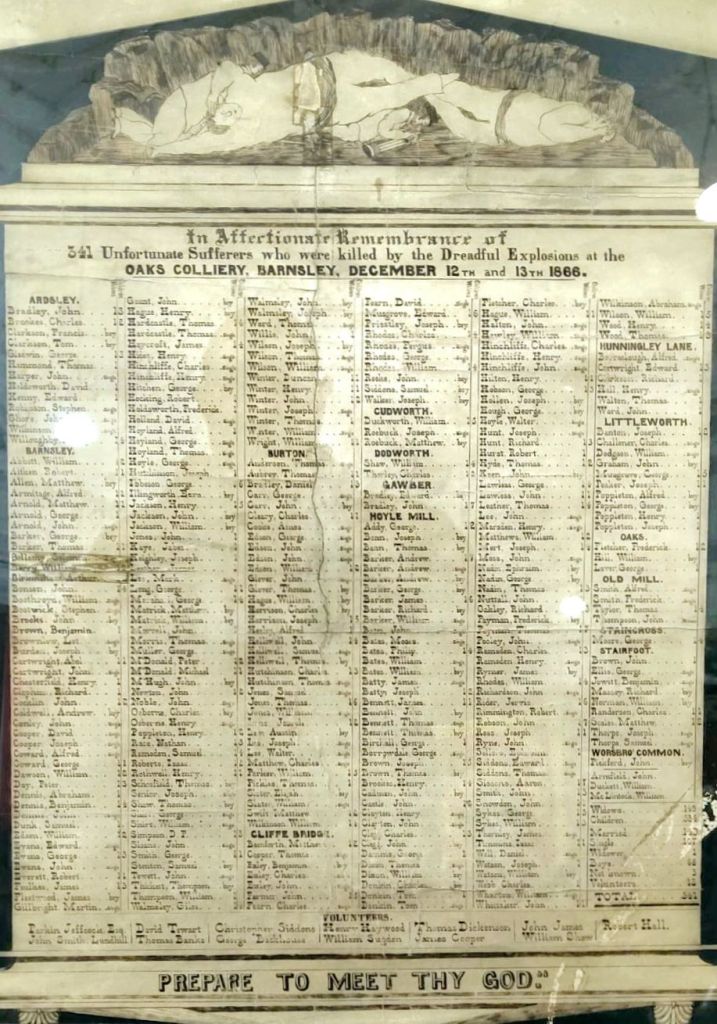
A memorial roll of names of some of the victims of the 1866 Oaks Colliery disaster (Photo Credit: Paul Moon)

NCB Mines Drainage Unit Diary 1955

As part of celebrations for ten years of work at Hemingfield Colliery, formerly a pumping station, FoHC Chair Steve Grudgings shares the results of some of his historical research into the working history of the National Coal Board’s Mines Drainage Unit (MDU) in 1955. Steve writes…

Introduction

It was 19 years ago (2005) that I parked outside the Westfield Newcomen Engine House at Rawmarsh and loaded up my old Skoda Octavia will a carload of “souvenirs” retrieved from the top floor of the building.

With hindsight, I realise it had been used as a storeroom for materials previously housed in the offices (100 yards up the road) and the workshops (adjacent) at Westfield. These presumably had been transferred when the NCB’s Mines Drainage Unit (MDU), based at Westfield had closed in 1989, and the premises rented out to new tenants.

1955 Diary

One item retrieved was a 1955 diary listing the MDUs daily activities and sites.

Sample page from 1955 NCB Small mines and Mine Drainage Unit Diary (FoHC Collection)

Given the absence of archival data describing their work during this period, I thought that after 15 years, I should examine it to see if I could make sense of the unit’s work at that time. Whilst the handwritten entries are not easy to read, there are at least four weeks of blank pages and the diary ends prematurely at 9/12/1955,  it has been possible to work out some of the unit’s activities, and my understanding of the main ones are set out below.

The NCB’s South Yorkshire Mines Drainage Unit

Following nationalisation of the Coal Industry in 1947, the MDU had taken over the work of the South Yorkshire Mines Drainage Committee (SYMDC), much of which was a continuation of what had been done previously by the South Yorkshire Pumping Association from 1920-1929.

It’s task was to maintain and repair the shafts, adits and watercourses by which water was removed from the abandoned coal seams, mainly but not exclusively those concerned with the Barnsley Bed, to prevent its descent into the deeper workings below.

SYMDC had operated under a tightly-controlled brief whereby the colliery companies whose workings it protected paid its costs on a proportional basis based on their working tonnage. With nationalisation, such controls were dispensed with, and the MDU’s work expanded across much of the NCB’s Yorkshire area, the unit apparently being called on whenever shaft repairs and temporary pumps were needed. Their extended geographical range is reflected in the diary.

Typical activities in 1955

Diary entries are made on a daily basis, with the first always being a summary of the main activities in the Westfield workshops. This is followed by brief entries for each of the sites visited on that day, often only a line summarising the day’s main activities.

The majority of their work appears to be concerned with routine examinations, clearance of watercourses, repair and replacement of pumps and repairs to pumping shafts, insets and pump lodges.

We don’t yet know precisely how many men worked for the MDU, but in 1955 but its subsequent scale suggested numbers between 20 and 30. There would have been a small office staff of perhaps 5, and the rest would have been trained and experienced colliers, many of them qualified deputies. This qualification certified that they were competent with an additional set of safety related skills that allowed them, amongst other duties, to test for gas – crucial in old workings. The nature of their work and the conditions underground are difficult to understand 65 years on, but were clearly unpleasant, arduous and dangerous.

What follows is a site by site summary of some of this work, with a particular focus on the non-routine tasks. The most frequent activity reported for all sites is excavating and setting steels, i.e. digging out the spoil and falls from underground roadways and passages and installing semi-circular steel reinforcing rings.

This work is normally preceded by an entry in the Westfield workshops for cutting and drilling steels, suggesting each batch of steel rings was custom made in terms of length and curvature depending on the shape and size of the roadway. Drilling was needed for the bolt holes, which had to be aligned when bolted together.

The Sites 

Westfield

The workshop complex, the engine house and headgear still exist today and are used for light industrial purposes. The MDU offices at Westfield House had been purchased by SYMDC in the 1930s and still exist a hundred or so yards up Westfield Road, now serving as a care home.

Printed reproduction of a photograph showing Westfield House, on Westfield Road, Rawmarsh, Rotherham South Yorkshire, shown in 1939 - a large, square 2 storey Victorian villa. Formerly the home of the Newbould family, colliery managers for Earl Fitzwilliam. It was purchased by the South Yorkshire Mines Drainage Committee and became the NCB Small Mines and Mine Drainage Unit Office for many years after 1947. It is now a residential care home
View of Westfield House in 1939 in ownership of the South Yorkshire Mines Drainage Committee (SYMDC) which became the office of the Small mines and Mine Drainage Unit after Nationalisation under the NCB (image from the 1939 Annual report of the SYMDC)

In 1955 the Newcomen Engine House, originally built in 1823, at Westfield served as a pumping station in its own right, raising water from the shaft into the Bottom (Low Stubbin) watercourse. The engine it contained having been decommissioned and scrapped around 1934. The nearby Westfield No 1 footrill gave access to both this and the upper complex of watercourses via cross measure drifts.

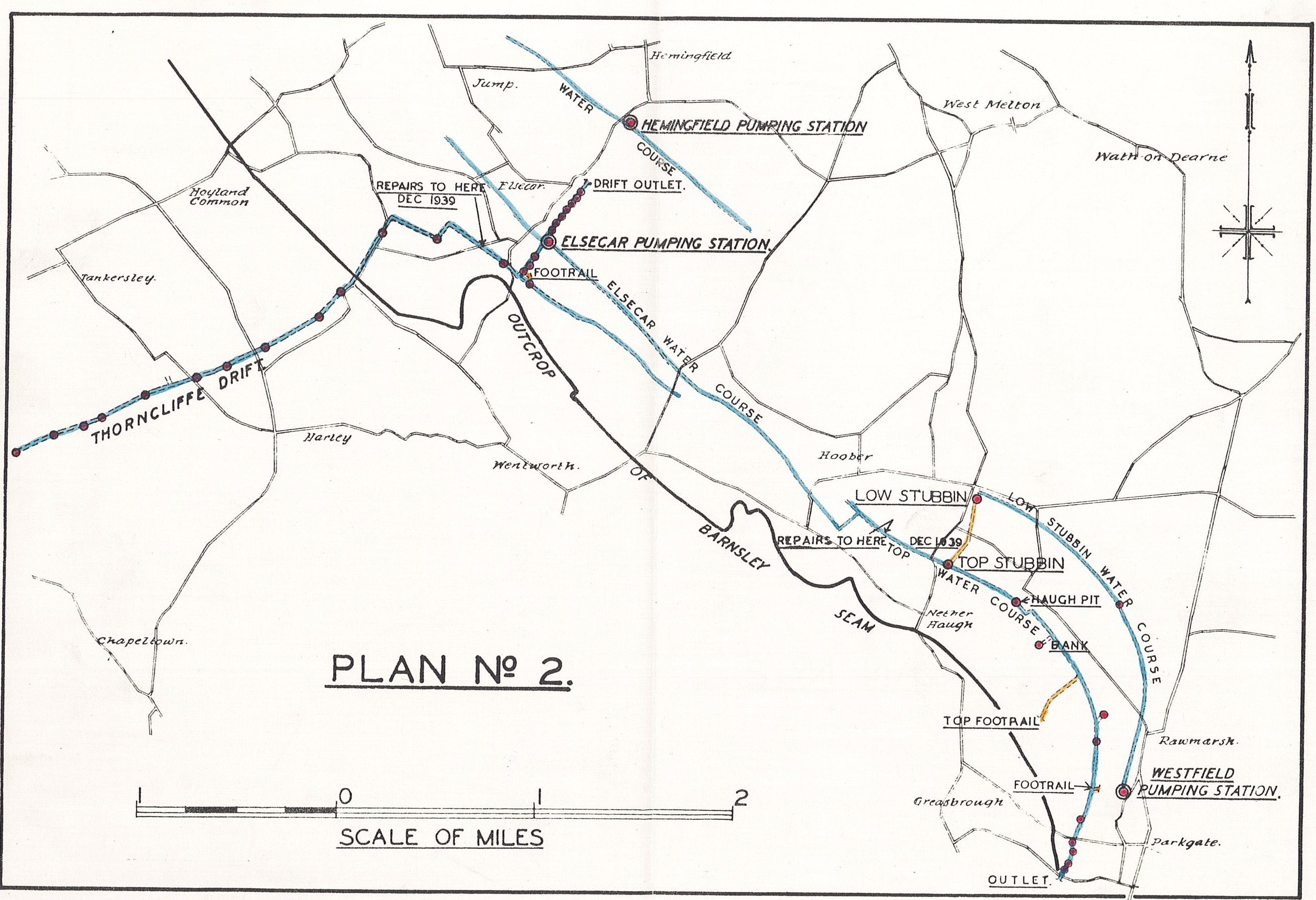
Plan of the drainage system from Elsecar over to Rawmarsh, taken from 1939 Annual Report of the SYMDC

These lengthy parallel watercourses ran in a north westerly direction from Westfield draining the area between Rawmarsh and the Elsecar Valley.

Many diary entries refer to motors, winders and pumps being rebuilt and repaired and there was much steel fabrication and electrical work too. Specific activities include:

  • In April and May 1955, the diary records construction of a headgear for the Milton Roadside shaft on the Thorncliffe Drift. This was then dismantling before being transported to site on 23/4
  • The unit appears to have had a couple of lorries (one registration was EET257 and another EET530) and vans and apparently a Ruston Bucyrus RB 19 excavator, which was under repair in February. In March the latter was at Strafford with it’s air receiver taken to Westfield for testing
  • Equipment such as mobile winders, cement mixers etc would have needed repairing and maintaining too. In January they report that the H&T (?) Engineer was repairing the 110HP pump which on 26/1 was returned to the works by BRS (does anyone remember British Road Services?).
  • On June 3rd they are capelling 85yds of ¾” rope ex digger for the 20HP pikrose ( a proprietary name for a small haulage engine) for Wentworth Silkstone” – it was delivered there the following day.
  • We know that the unit was capable and equipped to repair small colliery railway locomotives too. They made a workable loco from a pair of Ruston & Hornsby narrow gauge diesils locos being sold for scrap in 1947 for construction of Wentworth Drift mine is described by Adrian Booth in Industrial Railway Society Record No 103
  • There are references to repairing gates, redecorating and repainting cottages, presumably some of the MDUs local buildings, the headgear also received the painters attention on 8/2.

Hemingfield

The picture that emerges from the diary is of regular visits here with the main activities being weekly underground examinations requiring access to the pump lodges and various repairs and maintenance to the pumps .

View of Hemingfield Pumping Station from the Canal Basin, The pumping shaft headgear and engine house and winding engine buildings can been seen above the line of the old Elsecar branch railway and canal in the foreground. Photo taken in 1995
View of Hemingfield Pumping Station from the Canal basin level in 1995

Elsecar and the Thorncliffe Drift

Elsecar pumping station warrants surprisingly few mentions, possibly their needs were met by the adjacent NCB workshops and Elsecar Main Pit. In 1955, the MDU appear to have initiated a project to clean and repair the lower section of the Thorncliffe Drift and the local activities seem to be concerned with securing the various shafts accessing the watercourse (into which the water is pumped at Elsecar). This work included:

  • On 12/1 they report examining the drift from the outlet (near Hemingfield) to Milton.
  • In August, Westfield workshops are building shuttering for concreting work in the ladder shaft (adjacent to the Newcomen Engine House and giving access to Thorncliffe Drift) and in September 2nd the MDU are concreting the drift shaft top here.
  • The petrol engine in Crowther’s shaft (which was still open in 1990) is being dismantled and rebuilt between the 2nd and 5th of September and the Welfare shaft has its cap concreted on the 9th.
  • On the 12th September the Plantation shaft (upstream from Crowthers) has its top capped, and the next day the adjacent Elsecar footrill shaft is also capped. All these shafts are in close proximity around the current Heritage Centre, none being deeper than 40′.

This work on the shallow shafts appears to be linked to a major programme centred on Milton Roadside shaft some 1000 yards upstream following January’s initial explorations (implying it had been blocked for some time) and for the next couple of months work excavating and setting steels  is recorded.

In April, work at Milton roadside includes erecting the headgear built at Westfield, installing a 25hp winder and preparing the shaft including fitting timbers in a bailey bridge section in June.

Later in June they are laying the tub road and in July building a gantry and tippler, perhaps to clear accumulated deposits from this section of the drift (it was blocked and could not be travelled, presumably the reason for the work). The winder is still under construction on 4/8 when they report they are preparing for ventilation. Milton Roadside Shaft is on higher ground, 155’ above the Thorncliffe Drift water level hence the need for a proper headgear.

In September they are excavating shaft bottom and driving towards Milton House, the breakthrough to which is reported in October. They drove downstream because to do otherwise would risk being drowned by accumulated water.

Flockton Lane End

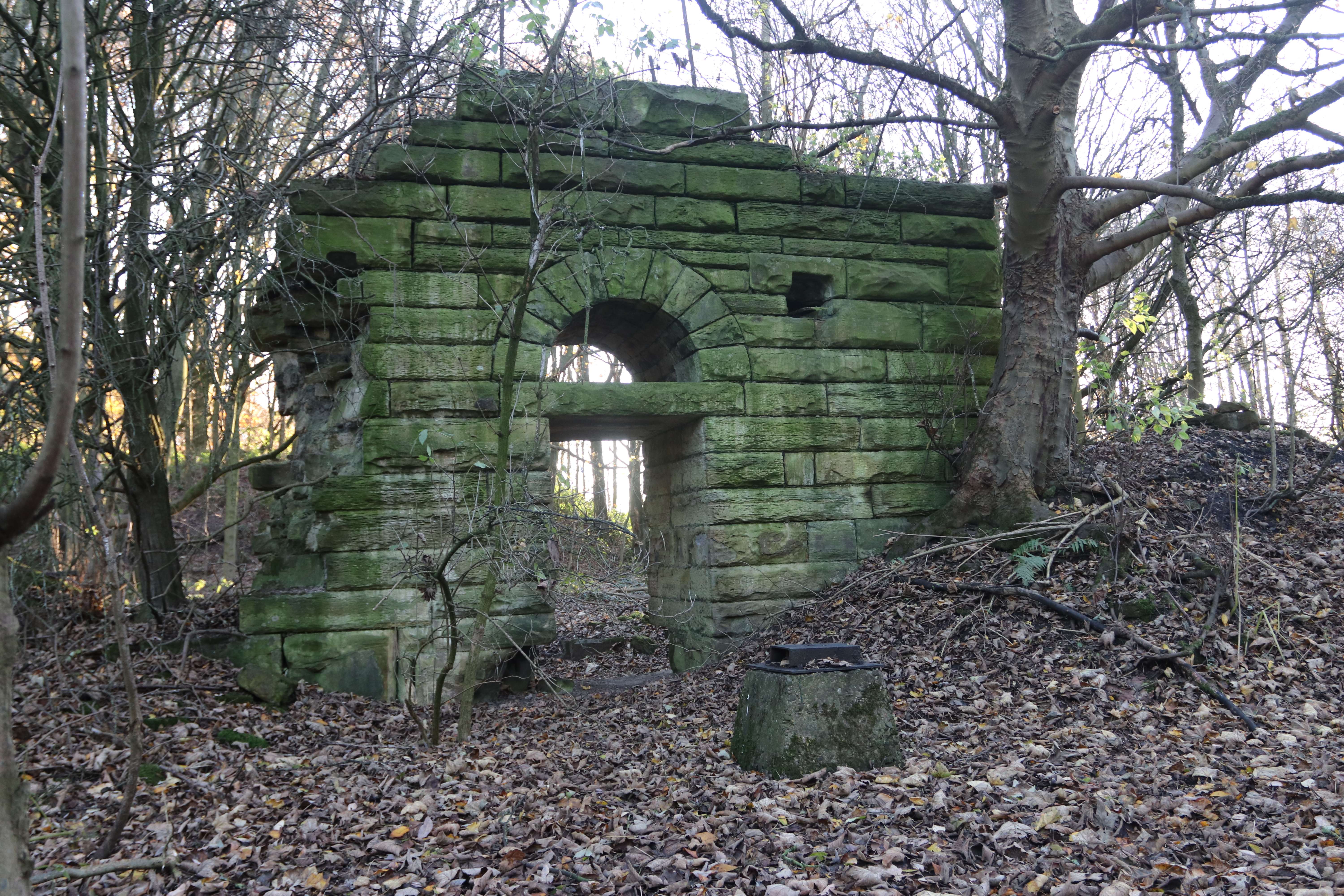
This pumping station in West Yorkshire had an almost daily entry and was probably the site furthest away from Westfield. It was a long established pumping shaft, draining a wide area of old workings south of Caphouse Colliery (today’s National Coal Mining Museum for England). The pumping engine house bob (beam) wall and capped shaft can still be seen today (2020).

The MDU men spent considerable time here, the shaft would seem to have been in poor condition and needing much repair work. The work described included installing and maintaining the new pumps.

View of surviving ruined engine house archive in a woodland setting. Formerly engine house of Flockton Lane End
View of ruined bob wall of engine house at Flockton Lane End, 1995 (Credit: Steve Grudgings)

Strafford

This pumping station was another frequent entry, and was some way to the west near Silkstone. Like Lane End, much effort went into repairing the shafts and pumps. On 5/2 the entries for Westfield record welding to Strafford hoppit telling us how the men accessed the shaft.

In October they used the MDU’s mobile winder to install new pump pipes in the shaft. There are a number of entries in Jan and Feb for repairing the water shaft, I am not clear if this is the pumping shaft or a separate one for water storage.

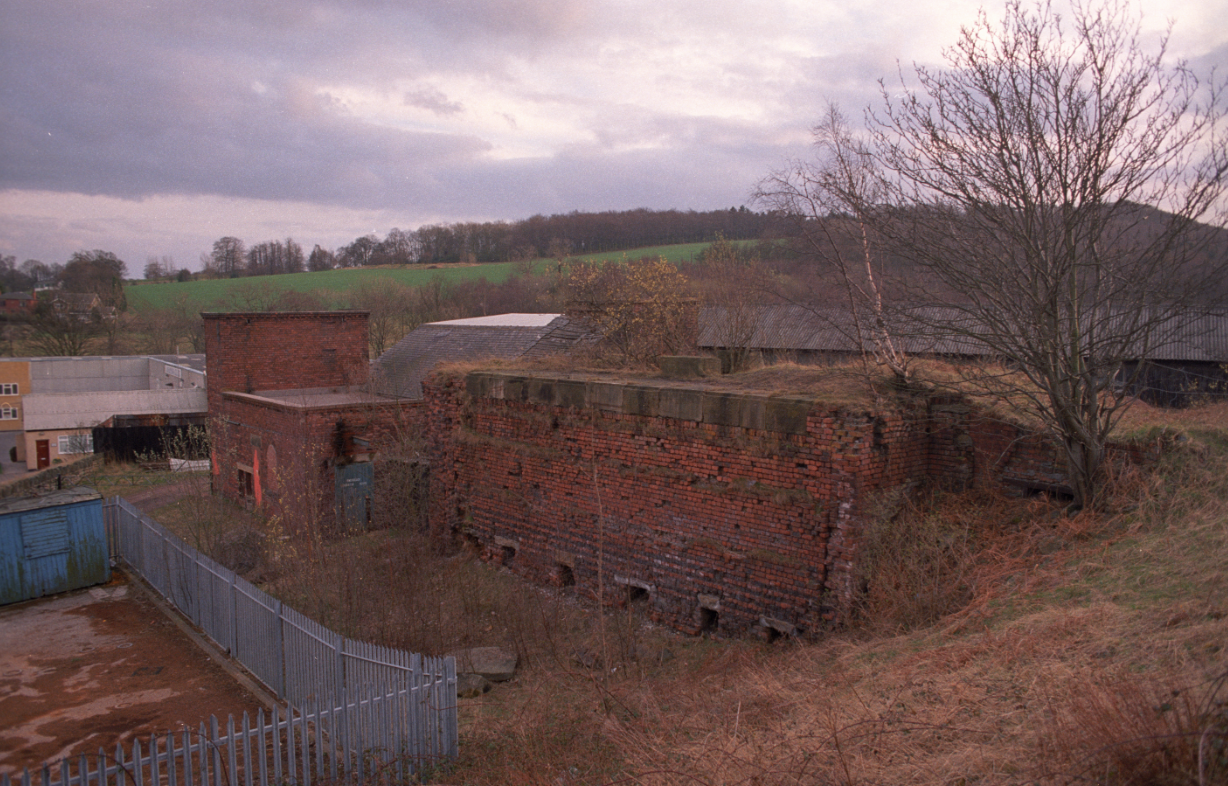
View of remaining buildings, including ruined fan house at former Strafford Main Colliery and pumping station close by, 1995
View of remaining structures at Strafford Main Colliery, including the fan house structures, next to the pumping station, taken in 1995 (Credit: Steve Grudgings)

Whilst on the subject of mobile winders, in the 1930s the SYMDC purchased a small lorry-mounted mobile winder to facilitate access to the number of shallow shafts they were responsible for on the various watercourses, and this may have continued in use into the 1950s. 

Low Stubbin

This was an old pumping station a few hundred yards North of Westfield, and another regular location, its shaft being used to gain access to the deeper of the two parallel water courses that drained the Barnsley seam there.

In January they were installing cables in the shaft and getting ready to send the winder to Low Shops. Low Shops was a closed J.J. Charlesworths pit in between Wakefield and Stanley Ferry, used as a workshops and presumably able to handle work that was beyond Westfield’s capability.

On 19 January (following a shaft inspection on the 13th – the only mention so probably being opportune) the portable winder was being repaired at Low Shops and on the 25th it was collected and installed at Low Stubbin. Low Shops site does not feature again in the diary

  • On 10 May they are preparing three (sheer?) legs for unloading a winch and also repairing the lorry winder (it’s unclear if this is the same one repaired at Low shops).
  • In July they report clearing the road (watercourse) to Top Stubbin ( north of Low Stubbin) and later that month fitting hanging chains and a detaching hook and new indicator bell – these would suggest there was a permanent winding installation here complete with cage and signals.
  • In August and September Low Stubbin is reported as being damped off, I wonder if this meant gas levels had prevented access, possibly due to the long burning underground fire around the adjacent Haugh Pit?
  • In October collection of the fan from Milton is recorded (presumably no longer needed following the Thorncliffe Drift breakthrough?) for installation at Low Stubbin. On the 14th, the diary records cleaning the road in the Oatwood Level (on the Bottom Water Course)

Carr House

The colliery here, just on the north side of Rotherham, had closed before nationalisation and the site converted into one of SYMDC’s pumping stations. It was active until the 1990s, and the remaining buildings were demolished in 2014.

Regular entries for the site all point to routine inspections rather than the remedial projects underway at Strafford and Lane End. In February they report repairs to the Well shaft and in April concreting the overflow trench.

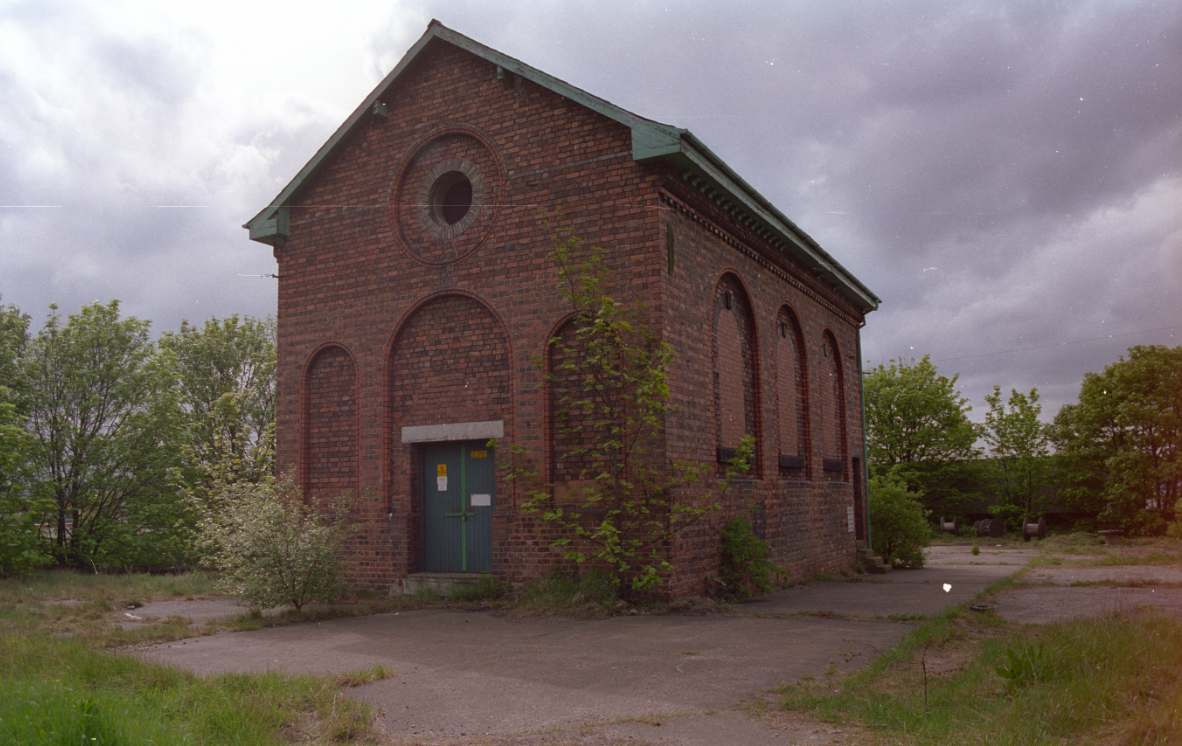
View of a brick engine house building at former Carr house colliery site in 1995.
View of Surviving engine house building at Carr house, in 1995 (Credit: Steve Grudgings)

Bore Hole

There is a lot of activity at the “bore hole”, its location is not described but I suspect this was at Barbot Hall near Greasbrorough where a borehole and submersible pump were installed and a small electrical switchgear house served by a lightweight headgear.

View across a field to Barbot Hall bore hole and headgear, 1995
View of Barbot Hall Bore Hole station

It is obviously a wide borehole as a 165HP Beresford Pump was installed in April and the following month shaft doors were installed. In July they delivered and fixed the winch and rope for the Pikrose, an electric motor presumably used for raising and lowering pumps and pipes in the borehole. Much of August and September was spent clearing out the shaft.

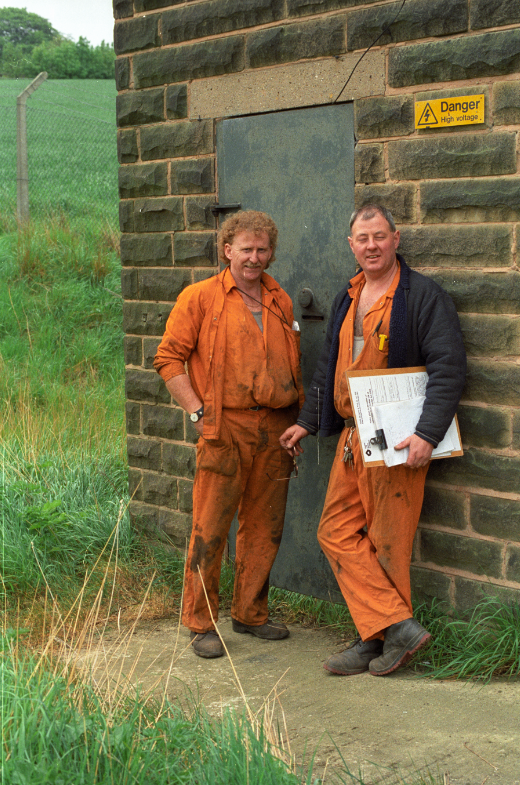
two mines engineers stood by doorway of Barbot Hall station 1995
Inspection visit by Dennis and Mel in 1995 at Barbot Hall (Credit: Steve Grudgings)

Waleswood

This colliery to the south east of Sheffield closed in 1948 and was adapted as a training pit and pumping station, and not finally demolished until the 1990s.

The MDU were busy repairing the Hazel Drift in May and Barnsley pit bottom in June but no further activity was recorded until 30/11 when they reported. Repairs to remove old rising main from surface to Hazel (seam) leaving Hazel to pit bottom in to conduct Hazel water to bottom. Wiring signals in UC shaft after all wire had been stolen!

Photo of a coupe of the few remaining surface buildings at Waleswood colliery, 1995
View of surviving buildings at Waleswood in 1995 (Credit: Steve Grudgings)

Skiers

This was both an opencast and deep mine site in the NCB era, and the MDU delivered 16 pipes to stores here on 28/1 and reported digging cable trenches  and the dismantling and return of the Pikrose the following month.

Shafts and Watercourses

There were a number of sites on the Top Watercourse discharging at Mangham that the team worked on. It was reported on 4/1 that work had been completed on the  Top Water Course and that they had travelled from the outlet to the Fire Wall (presumably where the underground fire had been sealed off since the previous century).

  • The Mangham outlet at Parkgate was being repaired for much of the summer and they are “loading muck away to outcrop” on 8/7
  • In July they are repairing Low Deep shaft top where the lock had been broken and sleepers thrown down the shaft. This shaft is at the southern end of the Top Water Course and had obviously been closed some time ago and its top covered.
  • Mangham Shaft is being capped on 14/9 and steels being set the next day.

There are other sites that get one or two visits and these include East Ardsley (south of Leeds), Hatfield Borehole, installation of a temporary pump at Goldthorpe and transport of a pump to Wheatley Wood.  The unit also installs what appears to be a submersible pump at Walton Colliery (Wakefield) in late June and July.

It’s also clear from the occasional diary entries that the MDU worked closely with local pits such as Silverwood, Nunnery and Cortonwood for supplies of materials and for workshop activity beyond their capacity. The withdrawal of 30 and 65hp pumps from Cortonwood is also reported on 22/8, I wonder if this refers to the end of pumping at Greenlands shaft between Cortonwood and Hemingfield?

Summery stamina, July and August 2024

Our regular volunteers definitely made the best of a bad summer, visiting site on the 13th, 20th, and 27th July, and 3rd, 10th, 17th, and 31st August.

Headgear between the heavens and the earth, 5th July 2024

We also had some special visitors on Friday 5th July, and Weds 21st August but more of that anon…

Continue reading

June

Unfriendly weather, but not entirely dull. No sign of summer sun. June was the summer-free month, uninterrupted by good weather. Volunteers were on site sporadically throughout, on the 1st, 8th, 22nd and 29th June. Inbetween them came rain and cloud. Frequently. Unreasonably unseasonal weather kept us away, and yet it proved to be a very memorable month as you will read.

Continue reading

Celebrating 10 years – remembering the first steps

In this special Anniversary post, Chair of the Friends of Hemingfield Colliery, Steve Grudgings shares the first selection of reflections on a decade of challenges, progress and change at Hemingfield.

Celebrating 10 years of the Friends of Hemingfield Colliery
Continue reading