114 years ago, in July 1911, the Society of Chemical Industry held their Annual General Meeting at Sheffield.
Arms of City of Sheffield (Sheffield and Rotherham Red Book, 1908)
On Wednesday 12th July, members gathered at the Cutlers’ Hall to begin proceedings before a meal at the Grand Hotel.
Cutlers’ Hall, Sheffield, from a photograph by Trevethick and Parkin, printed in Sheffield and Rotherham up-to-date. A fin-de-siècle review, Diamond Jubilee edition, London: Robinson, Son & Co., 1898, p.4
Their gathering also included visits to related industrial sites, including local factories, collieries and ironworks. This post explores a couple of the highlights relevant to South Yorkshire’s industrial history with a focus on areas close to our own.
The 12th December is a dark day in history for Barnsley. The catastrophic loss of life which occurred when there were a series of underground explosions at the Oaks Colliery, near Hoyle Mill.
View of Oaks Colliery at the time of the first explosion, published in the Penny Illustrated Paper, Vol.XI, No. 273, 22nd December 1866, p.397
On this day in 1866, 158 years ago, the first fateful explosion took place, to be compounded by a second explosion the following day as a search party explored the workings.
It was an event of regional, national and, indeed, international importance, with reporters being despatched from far and wide to report on a disaster the horrific nature and scale of which only became clearer over time.
Mr Montay, the London correspondent for the French newspaper Le Petit Journal set off for Barnsley by train on 14th December, arriving at the pit just before 1am on 15th December, he reported on a continuous procession of local people, miners, engineers, magistrates thronging the route to see if it was still possible to save a life, with thousands of people clamouring to learn the fate of the men underground.
Une procession continuelle, une longue file de paysans, de mineurs des pays voisins, d’ingénieurs, de magistrats encombraient la route.Tous tendaient au même but, tous allaient voir s’il n’y avait pas un-suprême effort à tenter pour sauver, ne fût-ce qu’une seule vie.
Le Petit Journal, Tues 18th December 1866, p.3
Others came to provide spiritual and emotional support, alongside local clergy including non-conformist preacher and friend of the poor from Rochdale, John Ashworth.
Ashworth’s short diary entries reveal in simple detail the shock and impact of the event:
Wednesday, Dec. 19. Visited the Oaks Colliery, scene of the explosion at Barnsley; conversed with Mrs Winter, Barker, and Cartwright; dreadful, dreadful, pit still burning, in which 300 persons are buried…
Thursday, Dec. 20. Felt very sad all day from the scenes of yesterday; the burning shaft is always before me…
Friday, Dec. 21. Received a letter from [James] Barker, Barnsley, giving particulars of his terrible search for his father and three brothers, after the explosion: all dead
Reproduced from Calman, A.L., Life and Labours of John Ashworth, Tubbs and Brook, Manchester, 1875, pp.120-121
He later wrote up his experiences in one of many collected short pieces published as Strange tales from humble life, entitled ‘Sad Story’ he described visiting the grieving families:
My next call was on the mother of James Barker ; the dear mother for whom he prayed when he found his three brothers amongst the dead. She resided at No. 3, Ash Row, Hoyle Mill. In this row of stone buildings, there are thirty dwellings, and, sad to relate, twenty-eight out of the thirty had one or more of the family amongst the dead. The angel of death had indeed visited these homes, and a great cry, like the cry of Egypt, had gone up to heaven. Groups of children, many of them too young to understand their loss, were playing about the doors.
‘A Sad Story’, Strange tales from humble life, 3rd Series, 1867, p.142
Investigation
Attending the subsequent Coroner’s Inquest at the time, Joseph Dickinson, a government Mines Inspector reported:
…the first explosion took place on the 12th of December, when 340 work-persons were employed in the colliery, of whom only six have survived the injuries, making the loss of life 334 by that day’s explosion. In addition to this, 27 persons, of whom four belonged to the colliery, and 23 who were volunteers, were killed by a succession of explosions (arising as it would appear from the pit having been set on fire by the first explosion), which commenced on the following morning whilst the workings were being explored for the purpose of rescuing any persons who might have survived and the bodies of those who had perished.
Joseph Dickinson, writing from Pendleton, Manchester, 7th February 1867.
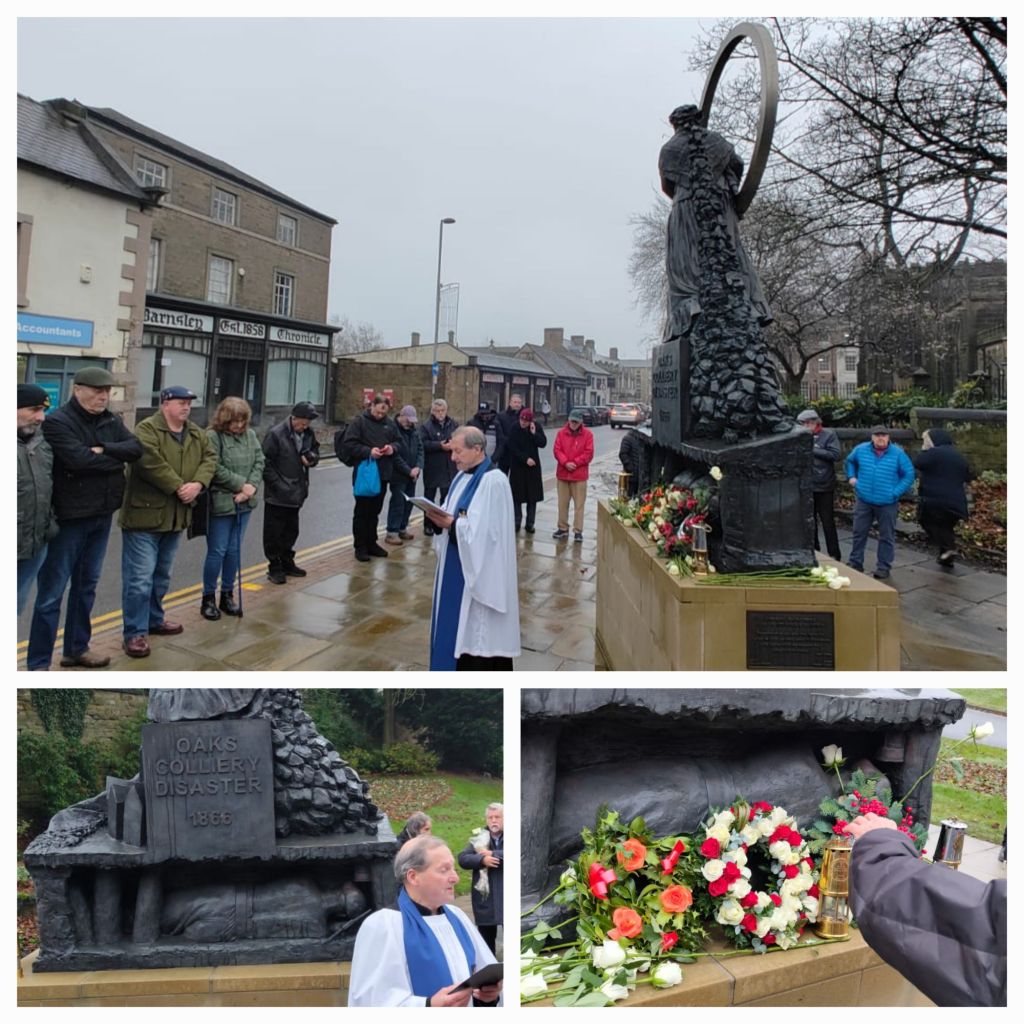
Returning to the present day, an outdoor service took place at the Oaks Colliery Disaster mining memorial sculpted by Graham Ibbeson, on Church Street in Barnsley town centre which was inaugurated in 2016.
Photographic collage of memorial service in Barnsley, 12th December 2024 (Photo credit: Paul Moon)
The Friends of Hemingfield Colliery were pleased to attend the solemn and reflective service.
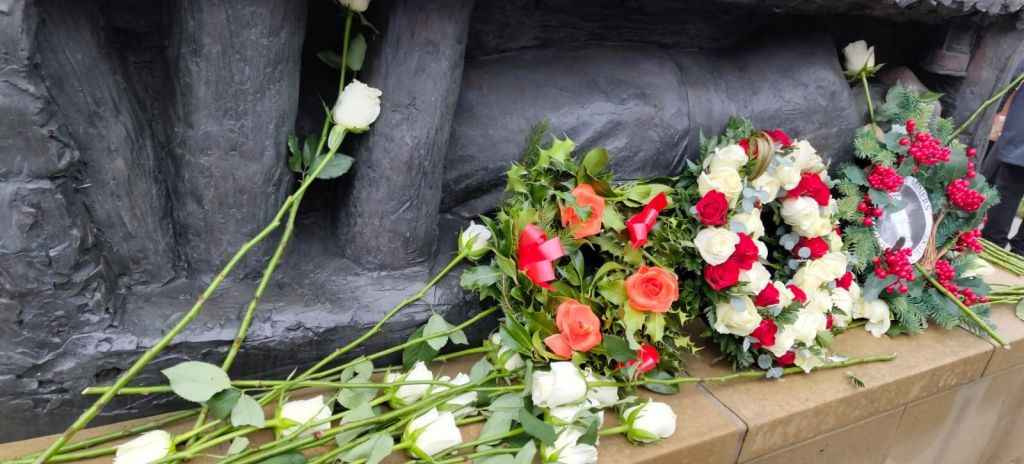
Flowers laid at the memorial
Attendees laid a white rose on the memorial in a poignant tribute to the lives lost so long ago. We will remember them.
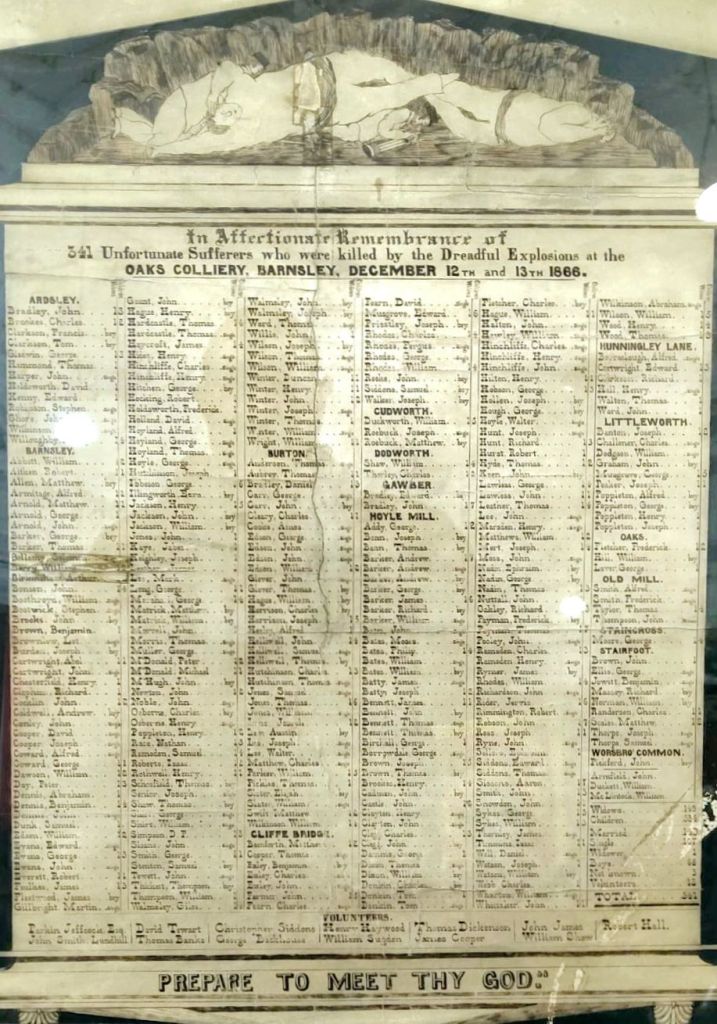
A memorial roll of names of some of the victims of the 1866 Oaks Colliery disaster (Photo Credit: Paul Moon)
November, the awkward month; no longer light, no proper time of day. The harbinger of winter gloom and colder comforts, but with festive frolics to follow. And yet, through it all, the volunteers’ job is never done. The Friends of Hemingfield Colliery are friends for all seasons!
Sunlight highlighting the hillside up at Hemingfield village
Bright and early. Dawn chorus. Fortified for the day, the Friends and regular volunteers made an extra-early start on Saturday 23rd January 2022, at 8.30 a.m.
This weekend the group continued work on the renewal of the garden of Pump House Cottage, and improving accessibility to the site to suport our National Lottery Heritage Fund project – Hemingfield’s Hidden History. All the while basking in the presence of a summer-like sun!
“It was a beautiful autumn morning. Such days come seldom at this season of the year in Yorkshire. When they do come one enjoys them all the more.”
Mexborough & Swinton Times, 3rd November 1906, p.11
And so it was on Saturday 13th November 2021, 115 years later; another beautiful autumn morning. The Friends and volunteers arrived early for another productive day’s activities at Hemingfield Colliery.
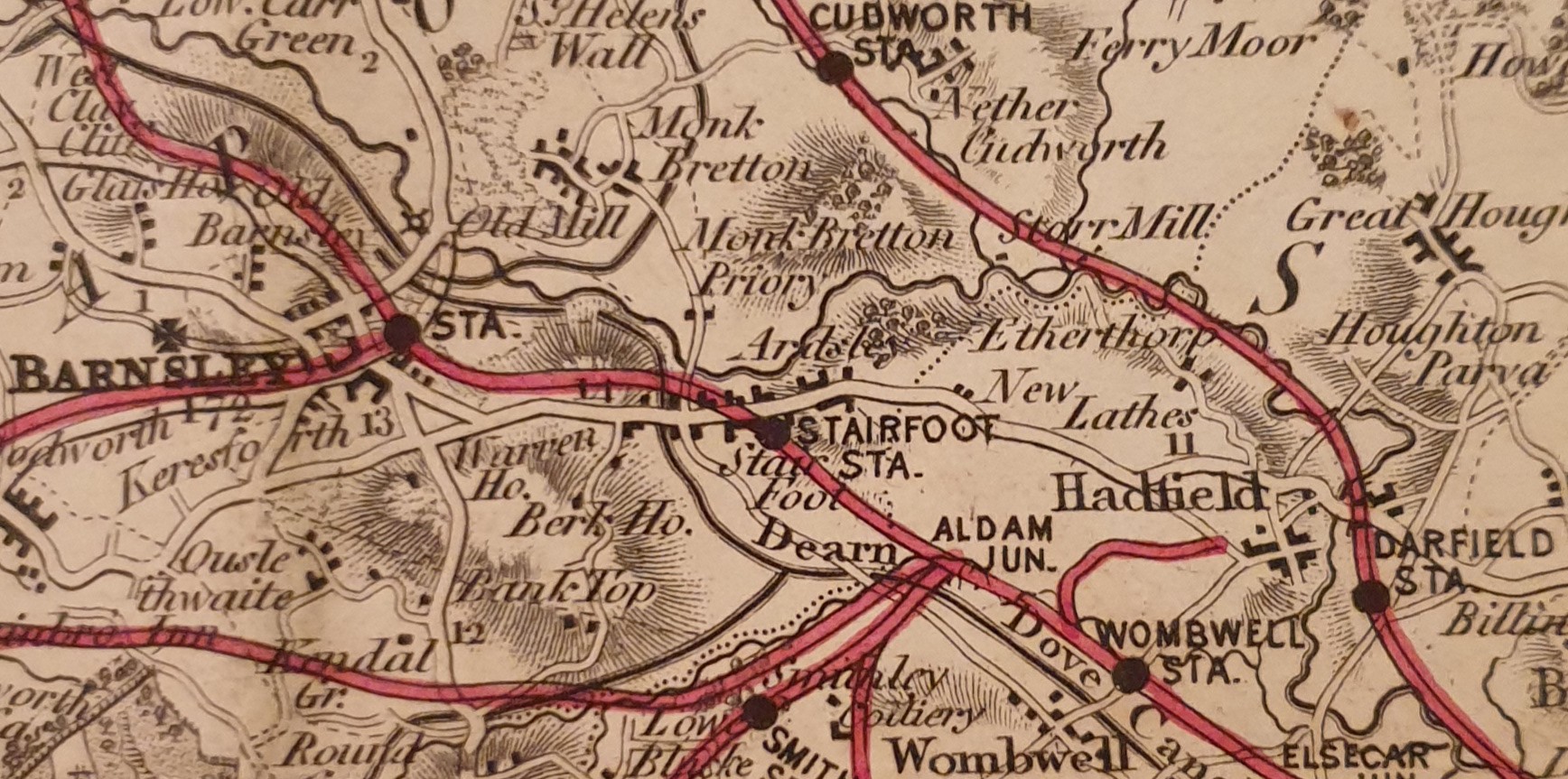
Oaks Colliery was just by the Barnsley to Doncaster line of the South Yorkshire Railway, between Ardsley and Barnsley itself, near Hoyle Mill (Crutchley’s Railway and Station Map of Yorkshire, 1861)
On the 12th December 2020, we remember the terrible mining tragedy of the Oaks Colliery Disaster of this date 154 years ago – Wednesday 12th 1866, at a colliery site now maintained by the Barnsley Main Heritage Group, and commemorated in a permanent public sculpture unveiled in Barnsley in 2016, 150 years after the event.
The Oaks Colliery Disaster Memorial, by St Mary’s Church, Barnsley
Providing a grim glimpse into that past, when the scale and impact were fresh in the mind, we can do no better than share extracts from contemporary words of a local writer and newspaper contributor, John Tomlinson (1834-1889) of Doncaster, as he visited Barnsley in February 1867, published in his Stories and Sketches relating to Yorkshire, Doncaster, R.Hartley, 1867:-
The Oaks Colliery two months after an explosion.
I took a bird’s-eye view of the landscape, which is here very irregular. The hills rise abruptly, with deep valleys between… I observed two rows of stone cottages; but all were silent. There were no busy steps passing in and out; no gossipping at the doors. A stranger passing this way might conjecture, without any previous knowledge, that some calamity had overtaken the inmates.
I stood between the two shafts down which so many had gone to the region of death… It was not necessary to linger on that gloomy pit-hill – a few moments sufficed for my eye to take in all objects on the surface – so I enquired the way to Hoyle Mill, where many bereaved families are congregated. As a result of this single calamity, we learn that there are here 50 widows and 113 fatherless children. Out of about 60 cottages which form this hamlet, there is left a male population numbering only thirteen who are capable of earning a living.
The Oaks Colliery
It is above thirty years since the first “corve” was brought to bank at the Oaks Colliery. For eight or ten years, while the mine was limited, no serious accident occurred. In 1845, however, there were two explosions, during one of which the pit was fired. Fortunately, on each occasion but few colliers were in the workings, so that only three or four lives were sacrificed.
Two years afterwards (1847) a far more terrible explosion occurred, and it was generally understood that the gas had accumulated in an old abandoned working. There were about a hundred men and boys in the pit, seventy-three of whom were killed, and twenty-six rescued alive. True, about that time (1848) some material changes were made in the organisation of the pit. The downcast shaft was converted into an “up-cast” or cupola, while the present no.1 and No.2 shafts, which had been sunk only to the upper seam and afterwards abandoned, were carried down to the lower levels, and employed as down-cast air and drawing shafts.
The depth of these is now about 280 yards, but the seam, which is above eight feet in thickness, dips so considerably that some of the workings would be at least 400 yards below the surface. It is computed that about 300 acres of coal had been got at the Oaks Colliery, the average yield being about 4,000 tonnes per week; that the pit contains about 60 miles of wall, and when the explosion occurred there were men in those distant levels, two miles or more from the bottom of the shaft.
The retrospect is very painful.
It is generally acknowledged that the Barnsley seem is peculiarly liable to emit sudden and extraordinary effusions of gas. The “goaves” are almost always more or less surcharged with gas, which, at times, is given off in such volumes as to necessitate the most careful working.
The reader is already acquainted with the general plan of the colliery. There are three shafts. The two “downcasts” are only a few yards apart, situate close to the South Yorkshire Railway; the upcast, or cupola being at a distance of about 500 yards from the former. The workings, as we have seen, are the most extensive in Yorkshire. There was a furnace, constantly burning under this upcast shaft to accellerate the draft, drawing up the return air, charged with gas.
Wednesday 12th December 1866
On the 12th of last December, three hundred and forty men and boys were down in this pit, alive and working. Of this number fully one-third would be husbands and fathers. It was nearly half-past 1 o’clock, p.m., when a terrible shock was felt, as if some heavy cannon had been discharged in the neighbouring hollow. But the colliery population knew well what such a sound betokened, and they rushed in consternation to the old pit-hill.
The sickening spectacle presented for the next few hours on that pit-hill will live for ever in the memory of the observers – charred, blackened, but not utterly lifeless forms are delivered to weeping relatives; and when such breathing remnants of humanity could no longer be found, disfigured corpses were brought up. Twenty human beings were recovered alive, but of these fourteen were so seriously injured that they have since died. These few living workers had made their way towards the shaft, where there was some measure of ventilation: those found in the distant workings were all dead, killed, probably, not by the explosion, but by the poisonous after-damp.
During twelve hours succeeding the explosion, about fifty bodies, in various conditions of ghastliness, were brought up from the pit. But there were scores of wives, mothers, and children who had not even these relics to comfort them; they went home in despair, if home it may be called, where the bread-winner could enter no more.
Thursday 13th December
On Thursday morning, about nine o’clock, another and louder report was heard. The earth shook and trembled, for the Fiend of Fire-damp was wroth. The shafts belched up smoke, coal-dust, soot, and broken timber, scattering the fragments far and wide. The bystanders were awe-strucken, and strong men wept with anguish as they recollected that twenty-seven explorers were then in the pit. The empty cage was lowered in silence and fear. It was afterwards drawn up, but it remained empty still; and then the bystanders felt that all hope for the brave volunteers was gone. Two men lay at the pit-mouth, and amidst a profound stillness “chucked” their voices down the heated shaft. There was no response.
During the day (Thursday, Dec. 13th) a third explosion took place, and in the evening a column of white smoke was emitted from No.2 shaft, accompanied by volumes of sparks. At this time all surface lights had been extinguished, while, excepting the presence of police, with a few coal-mine officials, the pit hill was quite deserted.
Friday 14th December
Between four and five o’clock on Friday morning, the watchers were startled by hearing the pit bell ring. It was not a mere hallucination, the sound was repeated, proving, contrary to all expectation, that there was life in the mine. A bottle of brandy was let down by a string; and when the latter was drawn up, the bottle was absent. Presently a rope and small cage, or tub, were extemporised (the winding-gear of both shafts being totally disabled), when two gentlemen descended the shaft.
At the bottom was Sam Brown, one of the twenty-seven volunteers, alive but nearly exhausted. The two explorers went some distance through the pit, searched and shouted; they discovered that the mine, in one place was on fire, but could find no other living human being. It excited great surprise that this Samuel Brown should remain alive twenty hours after that second explosion, in which all his associates had perished.
Saturday 15th December
On Saturday, December 15th, three or four more explosions took place. The reports were loud, and there was still a great emission of coal-dust, soot, and broken timber from the two shafts. The task of exploring the mine had long since been abandoned. To stifle the fire that cupola was first filled up. It was probably the best policy to choke the up cast; but during the next fortnight not less than a dozen distinct explosions were heard at the surface, some of them very powerful. Meetings of colliery proprietors and mining engineers continued to be held, and it was decided to stop the down-cast air in both No.1 and No.2 shafts. This was done. Then followed the coroner’s inquest, occupying many days.
Inquest and Aftermath
So far as we know, no catastrophe in Yorkshire, at any time, has cut off so many human beings at a stroke. After the first thrill of consternation had passed away, people said to one another – Now the public mind will be thoroughly aroused, and something must be done to prevent such disasters. The Coroner and jury sat thirteen days, and after listening to some evidence, and a great deal of scientific disquisition, returned the following verdict:-
“That Richard Hunt and others were killed by an explosion of fire-damp at the Oaks Colliery on the 12th of December, 1866, but there is no evidence to prove where or how it ignited. The jury think it unnecessary to make any special recommendations as to the working of mines, seeing that the Government is collecting information, no doubt with a view to the better protection of life, but they think a more strict inspection is desirable.”
Public excitement in relation to this great calamity is gradually subsiding. And now – What? The subject will certainly add another item to the details of local chronology. There has been two months’ twaddle about cause and effect, and now – What? I speak to men in authority, and practical men. Is the whole matter to be shelved, or evaporate in a few vague resolutions, until another similar casualty excites a parallel consternation?
There is one fundamental question which, to my mind, has never been satisfactorily answered:- Can explosions in these deep, extensive mines be entirely prevented?
The preponderance of testimony from mining engineers (and such men ought to know) is, that they cannot. Increased care, and superior ventilation, may lessen the severity or frequency of such accidents; but so long as the world lasts, while there are mines to be worked, and coal to be got, there will inevitably be jeopardy of life. It is so with our mariners. The ship may be good, and the hands may be experienced; there may be systematic and unceasing watchfulness; but some unprecedented storm, or treacherous quicksand, may render futile all human endeavours, and the coast will now and then be strewn with wrecks.
Commemorating the Oaks Colliery Disaster, 150th Anniversary programme of events.
A hundred years ago today, on the 15th May 1920, the last corf load of coal was raised from Earl Fitzwilliam’s Hemingfield Colliery. It marked the end of an era for the pit, as silence fell, albeit temporarily, at the main winding shaft.
What with Storm Ciara (pronounced keera) threatening proceedings, and suggestions of Storm Dennis barely a week away, the Friends threw caution to the – admittedly light – wind on Saturday 8th February 2020, and ventured down to site for a surprisingly storm-free open day at Hemingfield Colliery.
2020! The first Open Day in the new year and what a beautiful day. Bright blue skies above, clear views all around, and a quickening coldness which suggested frost, but was soon chased away by getting to work as the Friends of Hemingfield Colliery and the regular volunteers returned to the pit for another year of activity, in a new decade of life for the colliery.






 Friends of Hemingfield Colliery