The 12th December is a dark day in history for Barnsley. The catastrophic loss of life which occurred when there were a series of underground explosions at the Oaks Colliery, near Hoyle Mill.

On this day in 1866, 158 years ago, the first fateful explosion took place, to be compounded by a second explosion the following day as a search party explored the workings.
It was an event of regional, national and, indeed, international importance, with reporters being despatched from far and wide to report on a disaster the horrific nature and scale of which only became clearer over time.
Mr Montay, the London correspondent for the French newspaper Le Petit Journal set off for Barnsley by train on 14th December, arriving at the pit just before 1am on 15th December, he reported on a continuous procession of local people, miners, engineers, magistrates thronging the route to see if it was still possible to save a life, with thousands of people clamouring to learn the fate of the men underground.
Une procession continuelle, une longue file de paysans, de mineurs des pays voisins, d’ingénieurs, de magistrats encombraient la route.Tous tendaient au même but, tous allaient voir s’il n’y avait pas un-suprême effort à tenter pour sauver, ne fût-ce qu’une seule vie.
Le Petit Journal, Tues 18th December 1866, p.3
Others came to provide spiritual and emotional support, alongside local clergy including non-conformist preacher and friend of the poor from Rochdale, John Ashworth.

Ashworth’s short diary entries reveal in simple detail the shock and impact of the event:
Wednesday, Dec. 19. Visited the Oaks Colliery, scene of the explosion at Barnsley; conversed with Mrs Winter, Barker, and Cartwright; dreadful, dreadful, pit still burning, in which 300 persons are buried…
Thursday, Dec. 20. Felt very sad all day from the scenes of yesterday; the burning shaft is always before me…
Friday, Dec. 21. Received a letter from [James] Barker, Barnsley, giving particulars of his terrible search for his father and three brothers, after the explosion: all dead
Reproduced from Calman, A.L., Life and Labours of John Ashworth, Tubbs and Brook, Manchester, 1875, pp.120-121
He later wrote up his experiences in one of many collected short pieces published as Strange tales from humble life, entitled ‘Sad Story’ he described visiting the grieving families:
My next call was on the mother of James Barker ; the dear mother for whom he prayed when he found his three brothers amongst the dead. She resided at No. 3, Ash Row, Hoyle Mill. In this row of stone buildings, there are thirty dwellings, and, sad to relate, twenty-eight out of the thirty had one or more of the family amongst the dead. The angel of death had indeed visited these homes, and a great cry, like the cry of Egypt, had gone up to heaven. Groups of children, many of them too young to understand their loss, were playing about the doors.
‘A Sad Story’, Strange tales from humble life, 3rd Series, 1867, p.142
Investigation
Attending the subsequent Coroner’s Inquest at the time, Joseph Dickinson, a government Mines Inspector reported:
…the first explosion took place on the 12th of December, when 340 work-persons were employed in the colliery, of whom only six have survived the injuries, making the loss of life 334 by that day’s explosion. In addition to this, 27 persons, of whom four belonged to the colliery, and 23 who were volunteers, were killed by a succession of explosions (arising as it would appear from the pit having been set on fire by the first explosion), which commenced on the following morning whilst the workings were being explored for the purpose of rescuing any persons who might have survived and the
bodies of those who had perished.Joseph Dickinson, writing from Pendleton, Manchester, 7th February 1867.
Returning to the present day, an outdoor service took place at the Oaks Colliery Disaster mining memorial sculpted by Graham Ibbeson, on Church Street in Barnsley town centre which was inaugurated in 2016.
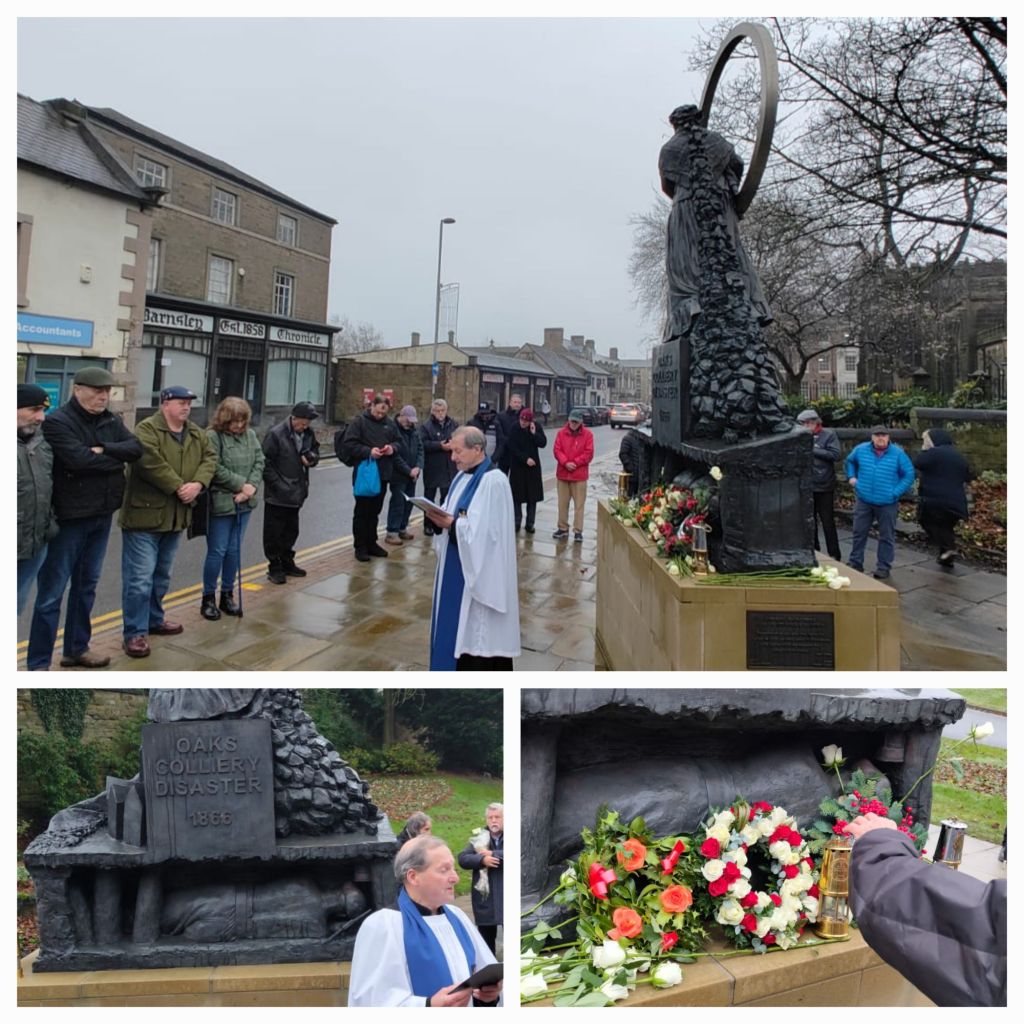
The Friends of Hemingfield Colliery were pleased to attend the solemn and reflective service.
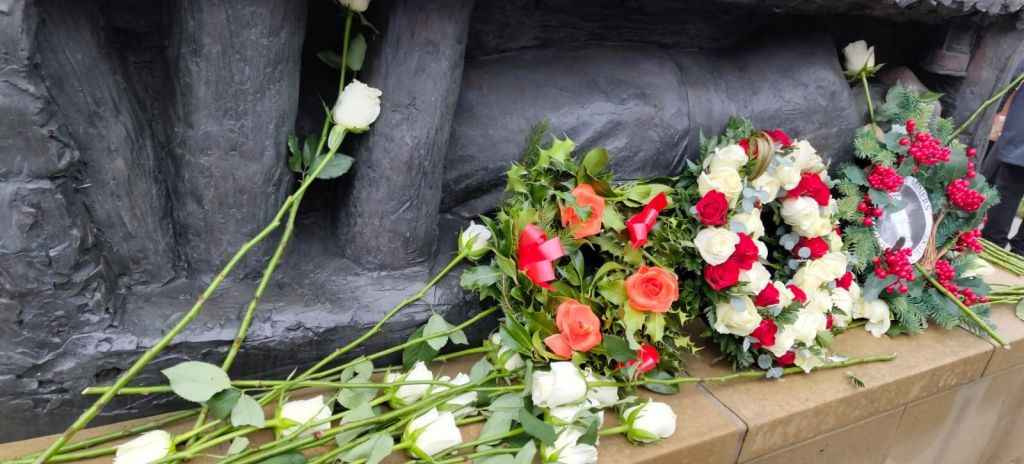
Attendees laid a white rose on the memorial in a poignant tribute to the lives lost so long ago. We will remember them.
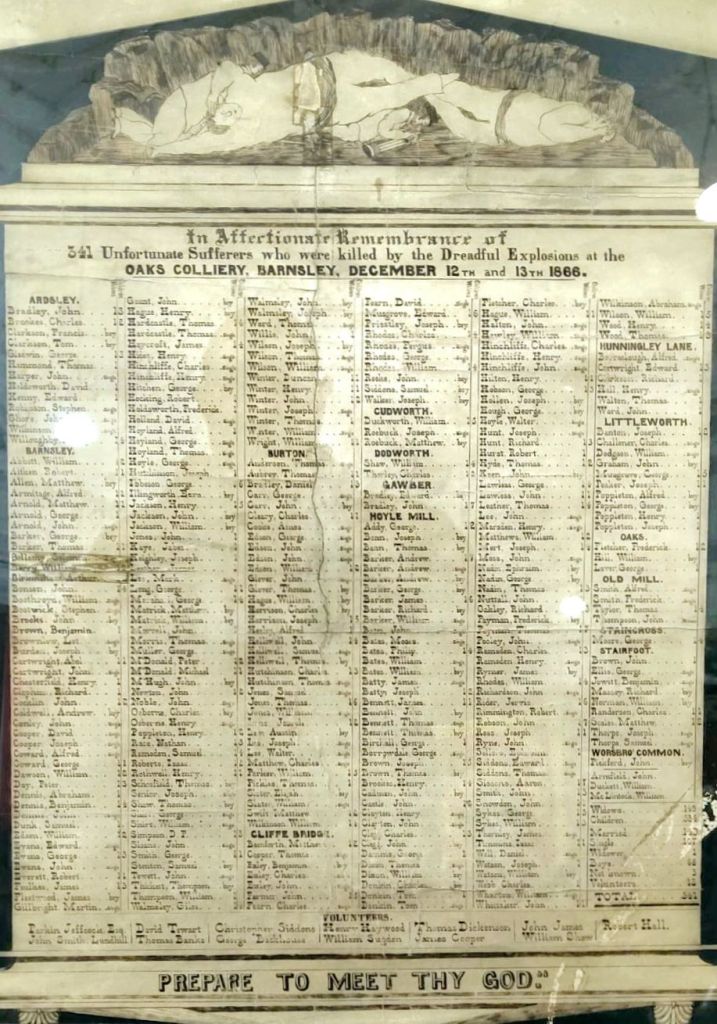

 Friends of Hemingfield Colliery