An unshiny, steady, sticking-at-it kind of month, with the Friends getting into a regular pattern of activity on site.
On Saturday 2nd March 2024, regular volunteers Paul, Mitch, Jeff, Chris and Andy arrived sharply and got stuck in to tidying, sweeping and gardening. Odd jobs you might say, but everything started and completed is progress for the site. Maintenance at least and conservation and restoration at best. And then there are moments of joy.

Last year’s National Lottery Heritage Fund Project Hemingfield’s Hidden History led to new connections, and the generation of new art working with the local school in Hemingfield. Looking again at the pupils’ artwork certainly adds a bit of warmth and sparkle to chilly and damp days in early Spring.
Heads up
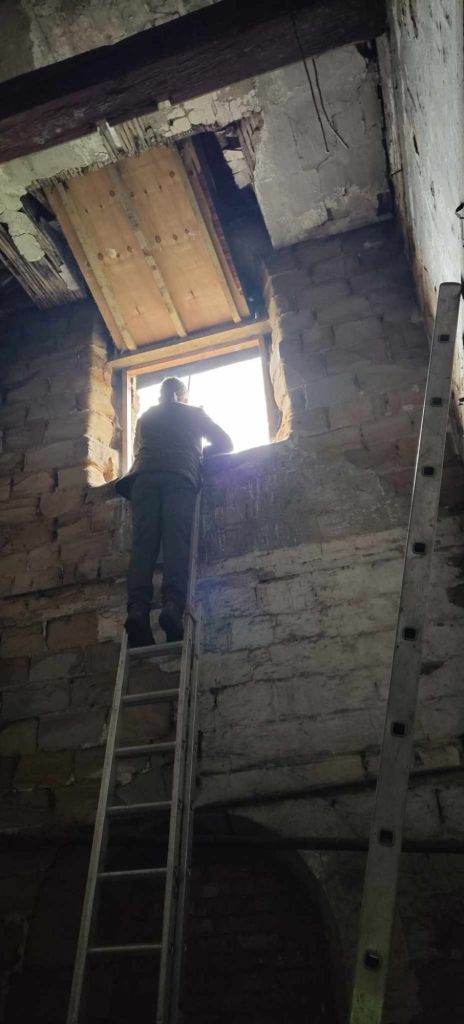
Meanwhile, Mitch and Paul took it upon themselves to measure up the open window space in the winding engine house, to block out the elements leading to pleasing photograph opportunities during the day.
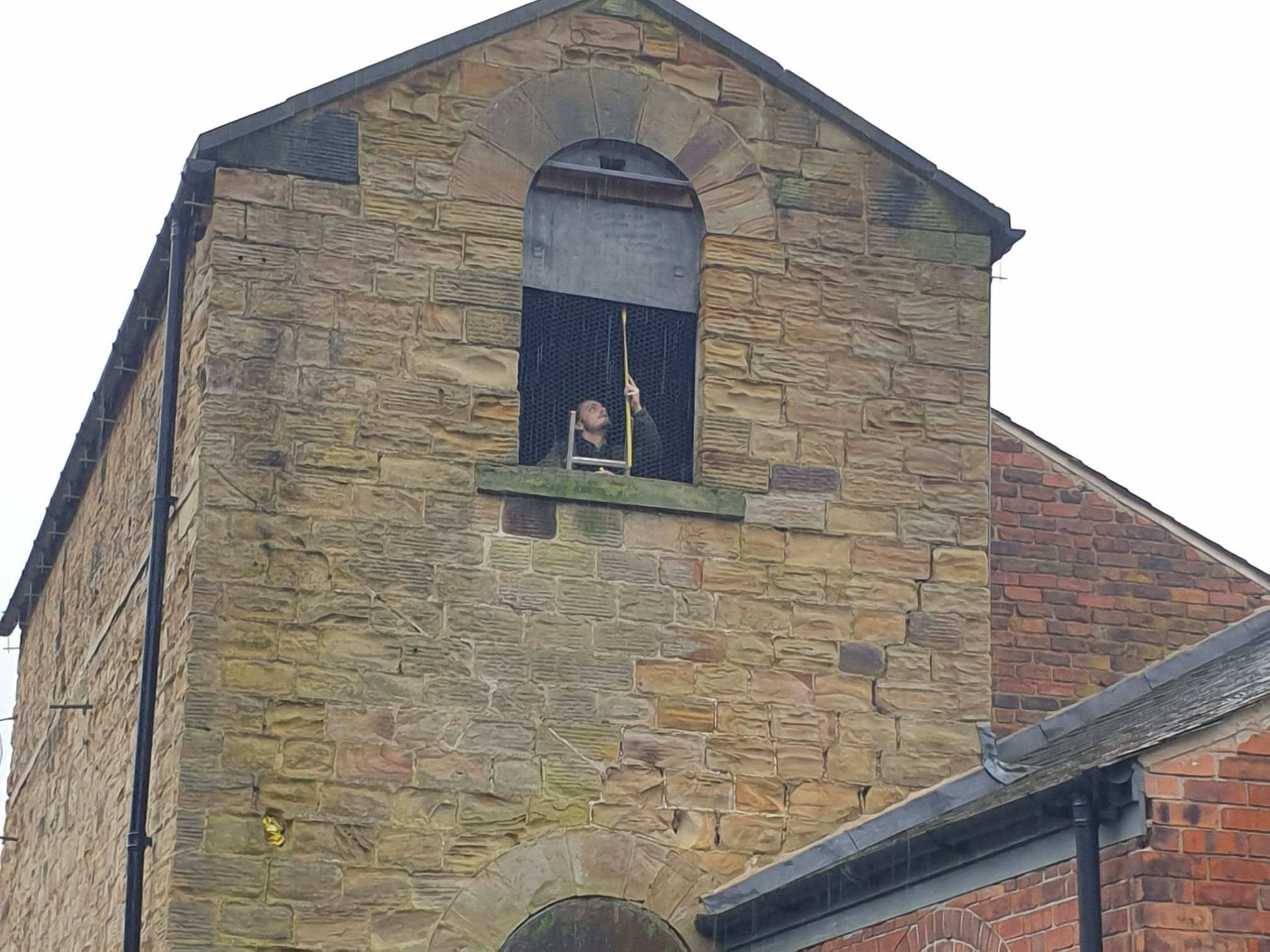
Signs of the times
We were also delighted to receive some new signage for the Friends to use on open days and when attending external events. Designed and produced by local graphic design company RC Graphix based just up the road in Hemingfield. Huge thanks to them for these lovely signs which show off our newer logo brilliantly and we look forward to warmer days when they will be on show!

Coat after coat

On 9th March 2024, Janet and Jeff, Paul, Mitch, Chris and Paul, were to the fore once again, and Janet in particular had been doing fantastic work on painting the railings, a long and detailed job, costing with grey and then holly bush green top match the drainpipes, lintels and doors in the same Fitzwilliam green seen around Wentworth.
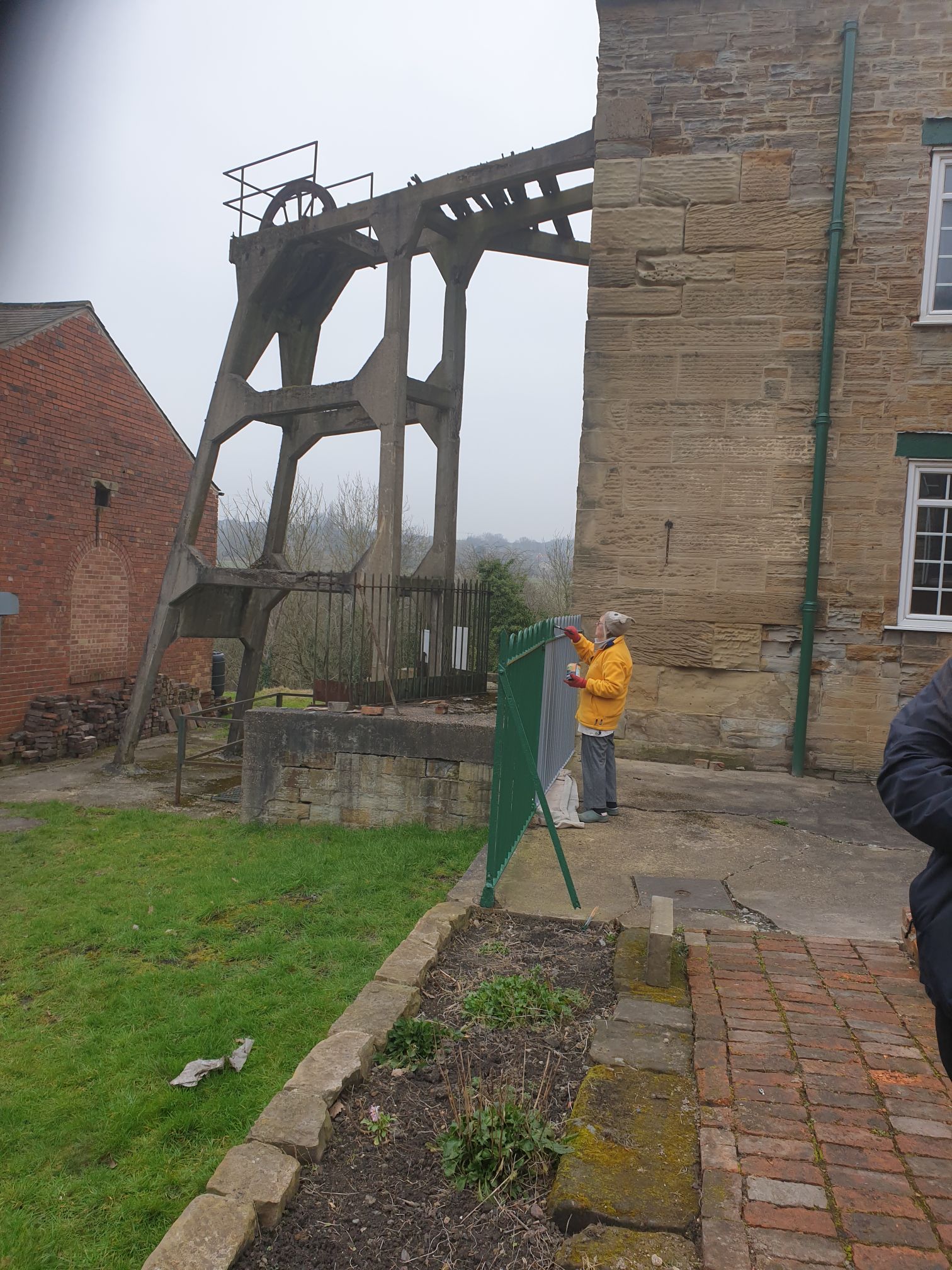
By the 16 March 2024, volunteers Paul, Janet & Jeff, and John, were joined by site supporters Andy and young David who enjoyed a tour of the site and a good look at the artwork exhibition upstairs in Pump House Cottage.

Further work followed on 23rd March 2024, when Janet & Jeff, Mitch and Paul kept things neat and tidy, before we managed to squeeze in a final session on Saturday 30th March 2024, together with Paul, Jeff, Janet, Chris, Paul, John and Jamie for a full house.

In addition to brushing up the pavement outside of the colliery, Janet continued the long and steady work of painting more of the rusted railings.
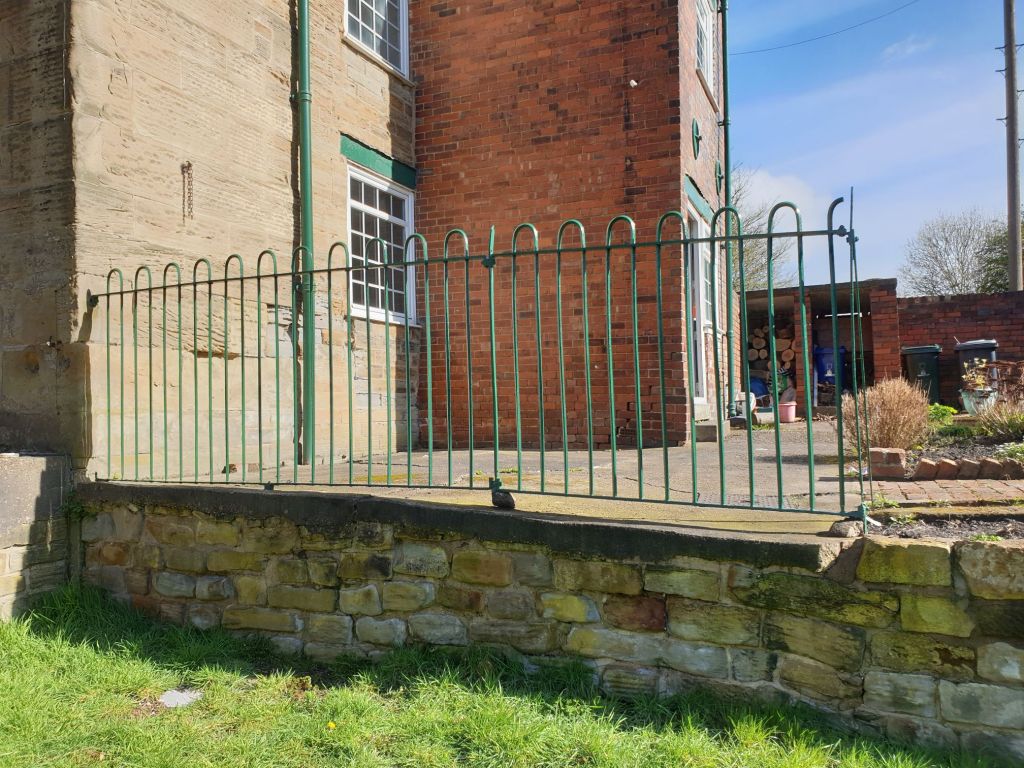
Having done the Pump House Cottage run, there’s the top yard set to undercoat next. Cracking job.

The sun made a cheeky, but most welcome, appearance as work proceeded in Pump House Cottage garden – both weeding and turning the soil, and a new repair activity, repointing (or even just pointing) the badly built front wall from the 1990s.

Quite a big job this one, but as the weather won’t permit us to do much major repair work on the rear wall, this is a great task which helps to ensure the boundary wall stays solid for many years to come.
Marching to a different beat

Still reflecting on 40 years on from the Miners Strike of 1984-85, and the slow march to industrial conflict that marked the end of large scale deep mining in this area of South Yorkshire. It is good to go back before the strike, and hear voices perhaps lesser-heard, or at any event unheeded or kept secret:-
I, as the miners’ president, want no part in leading any pressure groups whose sole object is to bring down the Government. Oh yes, I want Maggie Thatcher out. And I’ll fight to remove her. At the right time, and the right way. That means with an election.
Listen, I know it would be no problem to get something started with the mining industry. We are well-regarded by the working people. But I am not leading the trade union movement into a conflict with the avowed intention of causing chaos, to change the Government.
Some people may have this in their minds, but if we get involved in that little exercise it can only lead to Britain having a government that will in turn destroy the trade union movement as we know it.”
Joe Gormley interviewed by Brian James, Daily Mail, 19 Feb 1981
Prescient perhaps in light of what was to follow.
On the 8th of June 1981 in the Cabinet Office, the Central Policy Review Staff was requested by the then Prime Minister to prepare a first study on the National Coal Board/National Union of Mineworkers problem.
Led by a conservative businessman and outsider to Government, John Hoskyns, it was to assess the problems and present potential solutions for longer term strategic advice to ministers. The Prime Minister emphasised the importance of keeping very tight security on the study, so it makes interesting reading over 40 years later. The CPRS was asked to suggest answers to the following questions:
a) what is the fundamental nature of the problem?
b) what can be done to correct the balance of power so that it is more in the government’s favour?
c) what are the main implications of all this for other aspects of overall policy?
The answers came:
1. NUM power is based on:
- The importance of coal-fired power stations, which supply some 75% of electricity;
- The effective monopoly of supply through import restrictions
- Hence the possibility of a slow strangulation of the economy, together with a history which gives miners:
- a unique degree of public sympathy
- a unique community solidarity
- a particular claim on the solidarity of other trade unions
- plus a confidence based on the successful use of that power (or the threat of it) three times in the last decade.
- Government should view the problem as a continuing one. It will arise year after year, unless and until there is a radical change in attitudes, or in the balance of power. Each year is likely to have its special problems; for example in 1982 a new Chairman of the NCB and a new President of the NUM will be staking out their positions and there will be a particular risk of confrontation.
- However, it would be a mistake to regard any single year in the coming decade (1981-1991) as necessarily marking the end of the crucial phase of the balance of power problem.
- In the short-term the prospect of tilting the balance of power in the government’s favour is not good.
- Power station stocks and ability to replenish them cannot be brought to a level whereby a strike could be resisted for so long that the endurance of miners was likely to crumble.
- In 1926 most miners stayed out for 30 weeks in intense poverty, a determined and united miners strike would put the government in a more and more difficult position as the weeks passed.
- It is too early to predict precisely how the problems raised by Scargill should be dealt with. He is able and politically motivated, however when he moves to London his power-base may be more fragile. His former area Yorkshire will regroup, find a new leader and may distance itself from him.
- He will probably attempt to use a delegate conference rather than the NUM executive to reinforce militant policies, but at the end of the day he will have to carry 55% of a ballot…
In the event some things were well foreseen by the CPRS, and others were somewhat of a surprise, not the least the removal of the NUM headquarters from London to Sheffield!
The allusions to 1926 make interesting reading, and it is an important precedent in light of the successful secondary action which took place at the time.

Equally it has echoes in the picketing and new forms of rapid transport, the ‘flying pickets’ which characterised Arthur Scargill’s successful action in disputes of the 1970s (as well as a cracking music group in the 1980s!).
In 1972 and 1974, the NUM picketed power stations, docks, and coal depots, so that as well as coal, other essential fuel oil and maintenance supplies were cut off from the power stations. This meant that the usable power generation supplies were in jeopardy long before the Central Electricity Generating Board’s own stockpiles of coal were exhausted.
Changes in the law covering industrial action in 1980 and later were to change the balance once again, together with well-laid coal stockpile planning with electricity generators. Without a national ballot, NUM local strike initiatives would prove to be difficult to sustain nationwide, and not endorsed by other trades unions would not reach the breadth and depth of 1926 – even if they exceeded the length.
Delving deeper
Learning more about our mining heritage, about the working methods, working relations and labour conflicts will receive a significant boost in the near future, as the extensive but historically hidden and somewhat disorganised archives of the NUM and earlier bodies which were stored throughout the Barnsley NUM office, have now largely been taken into the care of the Modern Records Centre at Warwick University in Coventry. The story of taking on this vast archive, which is still being catalogued after major conservation work can be found in this fascinating article by the Society for the Study of Labour History, contributed to by the NUM and the MRC archivists:
https://sslh.org.uk/2024/03/06/inside-the-num-archive-150-years-of-coal-mining-history/
And even if travelling to Coventry is a stretch, visit their new digital collection on the 1984-85 Miners Strike Coal not Dole to see lots of contemporary materials online.
 Friends of Hemingfield Colliery