
March arrived, and Springtime had definitely landed with bulbs flowering, and sunshine blazing down on a small band of regular volunteers arriving on site to get busy in the garden.

But first things first. The Friends are delighted to announce that they have received grant funding from South Yorkshire’s Community Foundation (SYCF) to sort the costs of the site’s insurance costs.
This crucial funding ensures we can continue activities on site during 2025, and to hold events, fundraising activities and tours throughout the year ahead which we will be sharing and reporting back to the Foundation and, via our website and social media channels, to you or readers and supporters.
This is an immense boost for the group as the insurance cost alone takes up most of any fundraising activities we are able to run as a volunteer group.
On with the show
Janet, Jeff, Andy B., Andy J. and Chris were on site during Saturday 8th March, and the main tasks focused on a proper Spring Clean of the garden at Pump House Cottage.
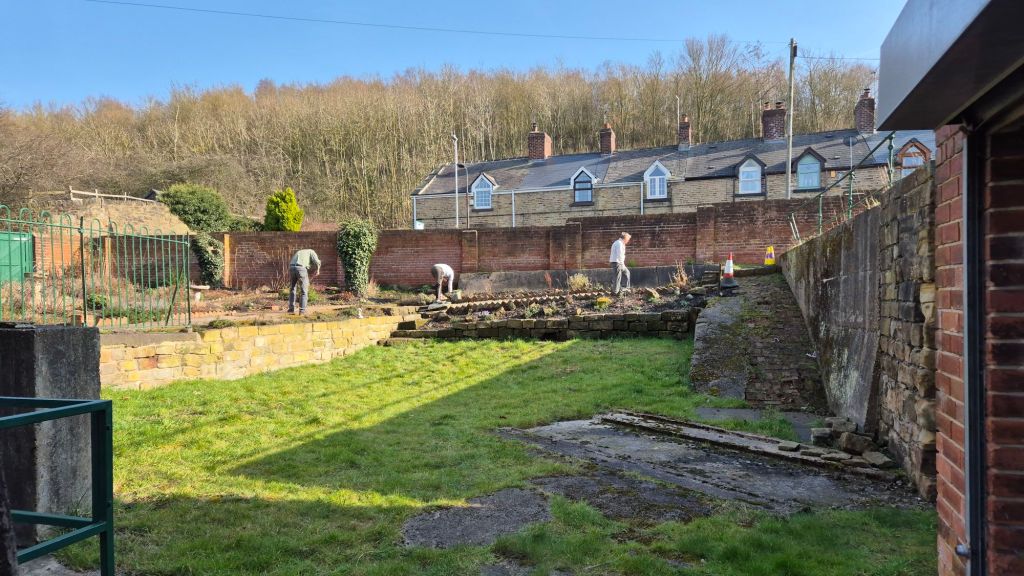
A Winter’s worth of weeding for one took most of the day. Together with scraping the muck and moss from the garden paths.

Elsewhere on site, sweeping up the pavement, cutting back weeds and trees, and tidying up bits and pieces in Pump House Cottage and in the Winding engine house.

All of these tasks saw everyone comfortably through to lunch, even as everyone was somewhat surprised at the heat of the sun – actual tanning could have been in progress!

Waterside rambles
Taking a break from site, and enjoying the sunshine, we’re always keen to check on the canal side interpretation board below the colliery and to inspect how the listed canal basin has weathered through the worst of the winter months.
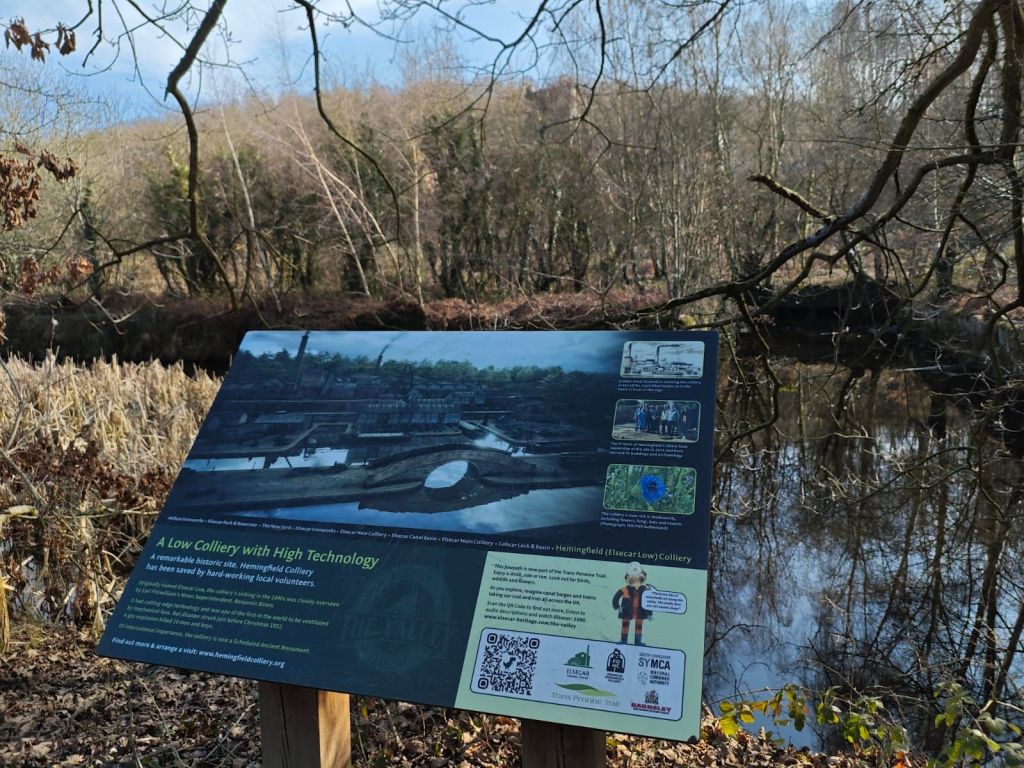
Best seen at this time of year, the trees are still thin, and the undergrowth remains sparse so the lines of the canal basin can clearly be seen.
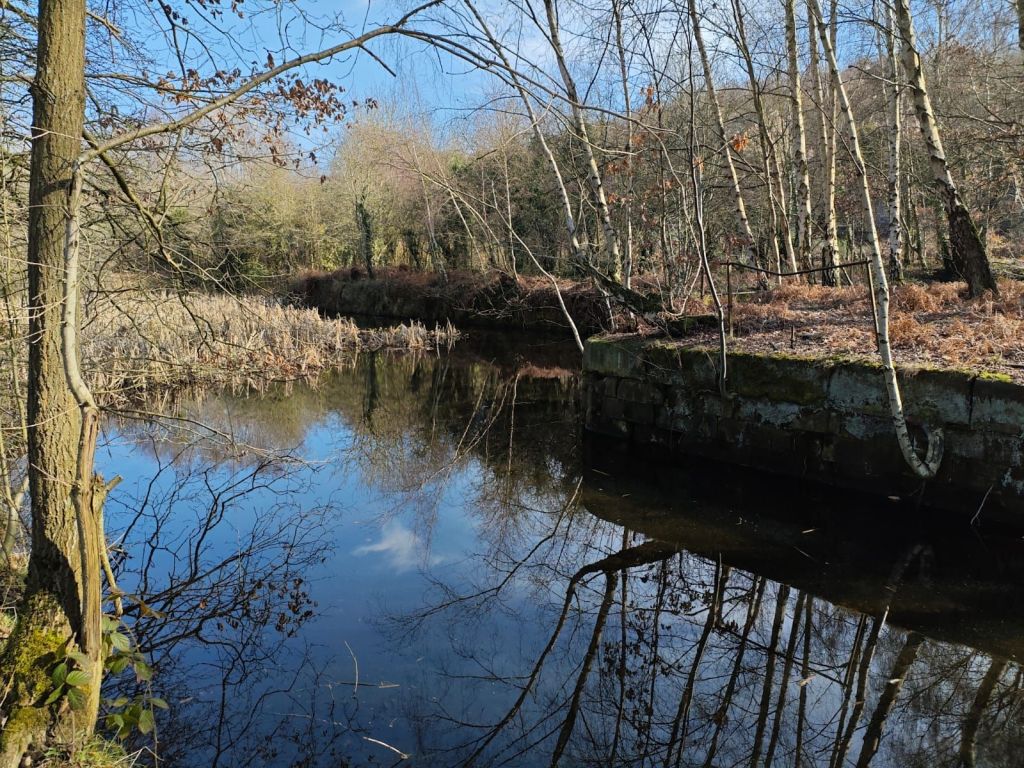
The bright sunlight and still waters of the Elsecar Branch of the Dearne & Dove Canal create wonderful reflections of the sky above.

It can be hard to see the canal basin for the trees nowadays, but the interpretation board and digital recreation do a good job of illustrating what the working scene of the canal basin filled with Humber keels being loaded with coal.

Seen in plan view from above, it would have looked something like the below:

And side-on, in elevation, this 1880s billhead illustration gives a sense of the basin at work.

Imagine the people at work on the boats, in the stables, or walking along the gantry and feeding tubs of coal from the main winding shaft, down into the waiting keels. We know a little of how it worked from an accident from 153 years ago on Monday 11th March 1872, when John Beardshall who superintended the loading fell about 15 feet from the timber walkway down onto the stone landing and then into the canal, breaking his leg. This space is now almost silent, empty of machinery and sound, except for birdsong.

At the back of the basin, visitors can take a look up at the colliery site, up over the old heritage railway track. The track bed was once the mineral line operated by the South Yorkshire Railway, exporing coal from the pits to the Great Northern Railway Company’s distribution links at Doncaster.
Now and then
Now for a little bit of time travel…
Looking at the entrance to Hemingfield Colliery, on Wath Road, opposite Pit Row, the sharp kink in the road can clearly be seen, as the boundary wall comes out into the modern road.

90 years ago this stretch of road featured in a list of speed restrictions by the West Riding Country Council, i.e. the “Unnamed road past Hemingfield Pumping Station to Hoyland Nether Urban District boundary” was restricted to 30 miles an hour, under the Road Traffic Act 1934. Anyone crossing this stretch would probably wish we could return modern cars to this sensible measure!

Glancing over the wall at that time, a visitor would have seen quite a different scene to today:
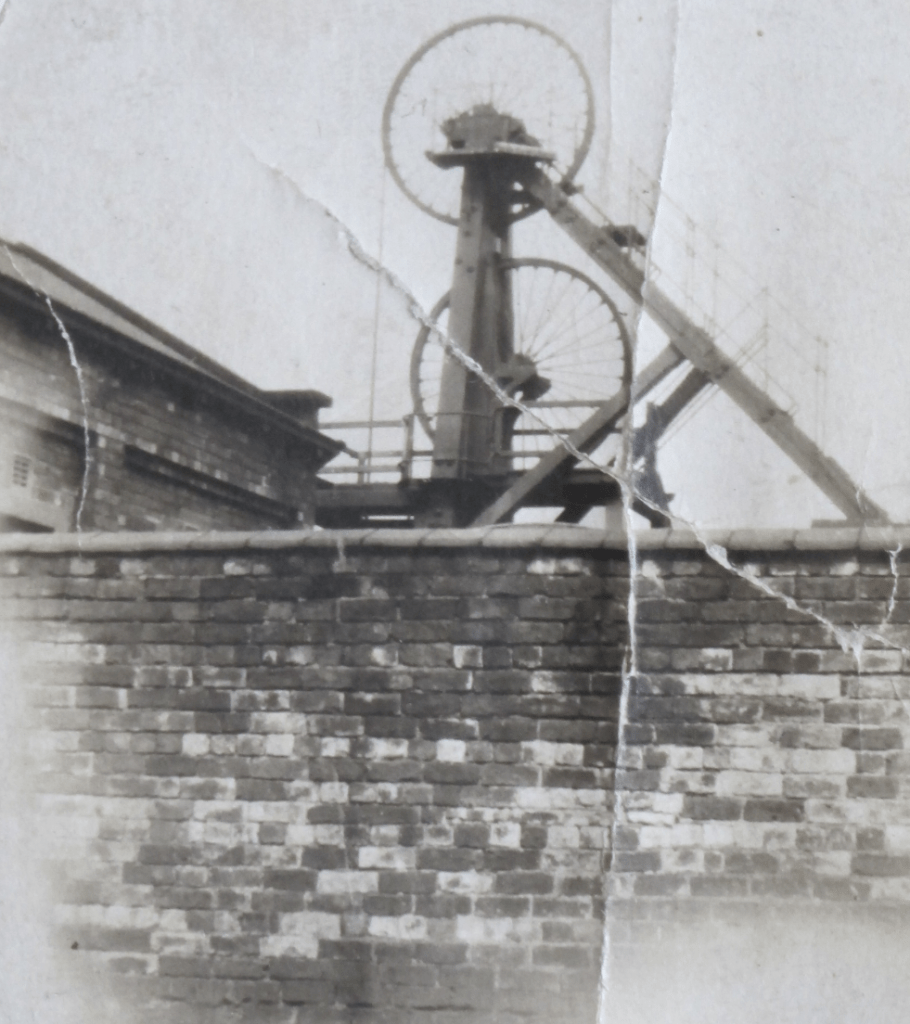
In 1939 into 1940 the timber headgear had been replaced by a concrete version.

At that time a visitor to the pumping station may have exchanged a word or two from Mr Thomas Ronald Ashton Goudge (1913-1971), living with his wife Grace in Pump House Cottage where he was employed as both an electrician and colliery winder.
Unfortunately for them, in October 1940, Goudge was summonsed by a local Special Constable for a breach of the lighting order made under Regulation No. 24 (Control of Lights and Sounds) of the Defence (General) Regulations 1939 which stated that every night from sunset to sunrise all lights inside buildings must be obscured, and lights outside buildings must be extinguished. Many people fell foul of these blackout orders, but the pumping station’s light could be seen a quarter of a mile away!
Progress
80 years ago, in 1945, the South Yorkshire Mines Drainage Committee who operated the site, provided the following report on Hemingfield Pumping Station:
“There are two shafts, each 154 yards deep, to the Barnsley Seam. Pumping is carried out from that seam, and also from an inset 60 yards deep, between the Kents Thin and Thick Seams, which deals with water from the shafts and from old workings in the Kents Thin Seam. The “water shaft” has been lined with concrete throughout, most of it before the war, but the last forty yards, inside an existing masonry lining, during 1945 in order to reduce the quantity of shaft water. […]
In connection with a proposal for rebuilding the substation it was discovered that highway improvement had been designed to take up most of the Pumping Station yard. An amendment of the proposed road line was secured.”
SYMDC Annual Report for 1945, 26th June 1946, pp.3-4
We’re grateful that the pit yard survived the road works, although the chipped bricks on the corner of the boundary wall by Pump House Cottage suggest motorists continue to struggle to get through!
 Friends of Hemingfield Colliery