Summertime. The Friends and volunteers returned to site for a brief spell as life continues to return to something akin to a norm. Hybridisation is the spice of life; we will grow and adapt.
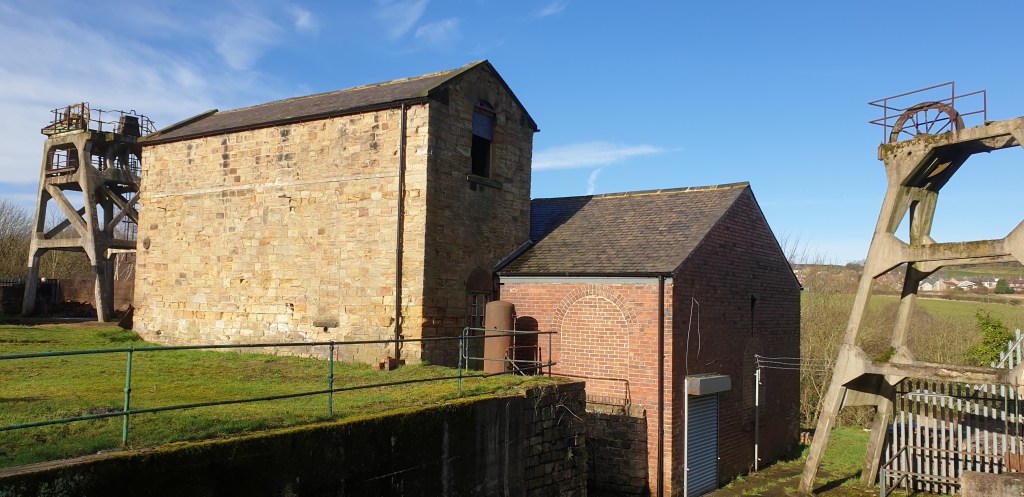
Sunshine heating, cloud conditioning. View of the main headgear from the roof beams of the old switchgear building
In the event the sun shone early doors, enough to burn outside although patches of light drizzle were an omen of developments after 3pm.
This is a recuperative post, covering a range of time from March into April 2021, as the UK’s lockdown began to ease, following a 4 step plan: a roadmap enabled by the extensive targeted vaccination programme proceeding since the new year. As the nation recovers normal activities, so hopefully will we!
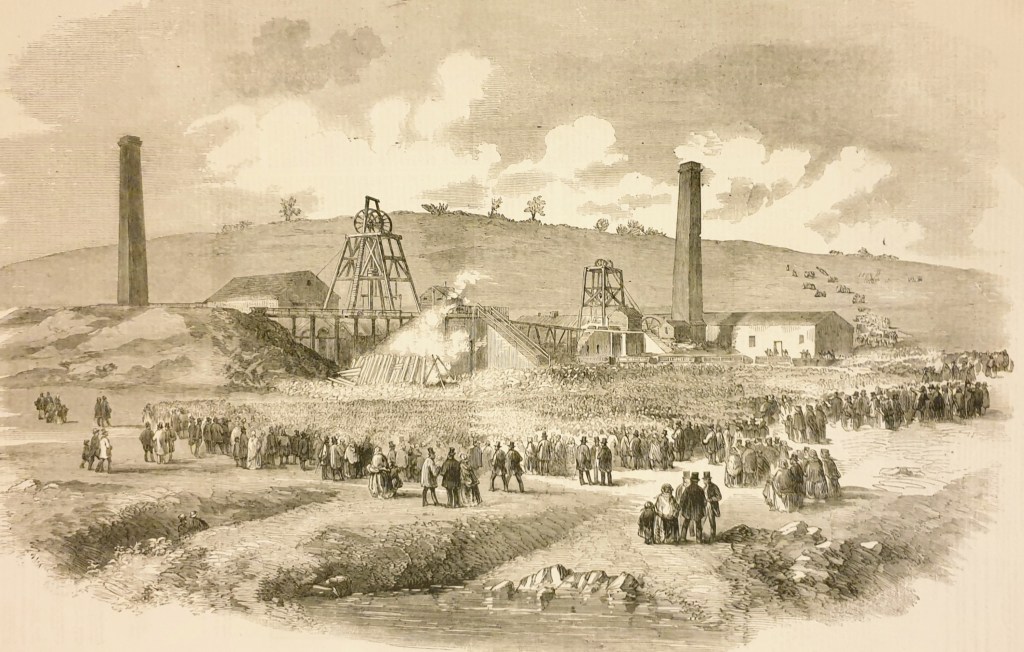
Engraved view of Lundhill (or Lund Hill) Colliery after the disaster, showing crowds assembled at the surface buildings (Illustrated London News, 28 February 1857, p.195)
On this day in 1857, a horrific underground explosion of firedamp occurred at Lundhill Colliery, between Wombwell and Hemingfield, claiming 189 lives, including 120 adults and 69 children.
Snippet from the Lundhill Colliery entry in Mines Inspector Charles Morton’s Report of the Working of the Coal Mines Inspection Act (18 & 19 Vict. c.108.) in Yorkshire, for the Year ending the 31st December 1857, HMSO, 1858, p.134
The impact on families in the community was catastrophic, leaving 90 widows and a total of 220 children without a father. We remember the victims and the devastating impact on the local community, and is a reminder of the serious dangers of working gaseous coal seams underground with the rules, practices and tools available at the time.
Hemingfield Colliery (also know as Elsecar Low pit) was working the same Barnsley seam, and employed the neighbours of Lundhill miners, so it was a community tragedy. Hemingfield Colliery itself had only too recently (Dec 1852) experienced its own loss of life via a underground explosion.
Working our way back to safe opening at Hemingfield
The Friends and regular volunteers returned to Hemingfield Colliery for another tentative and COVID-secure session maintaining the site as the country at large continues to open up following changes to government and Public Health England guidelines.
Returning to a new normal: a view of the colliery on Saturday 4th July 2020
Back. Working behind closed gates, and observing social distancing and regular hand sanitising, the Friends of Hemingfield Colliery made a careful return to site.
Volunteers working behind closed gates. Trying out the new requirements and taking steps towards more activity back on site.Continue reading →
A hundred years ago today, on the 15th May 1920, the last corf load of coal was raised from Earl Fitzwilliam’s Hemingfield Colliery. It marked the end of an era for the pit, as silence fell, albeit temporarily, at the main winding shaft.
Coronavirus is contracting space and dilating time, it seems. For their part, the Friends of Hemingfield Colliery continue their efforts, remotely: researching, planning and staying safe. We hope you and yours are safe and well. Our thoughts and best wishes go out to all those affected by this epidemic, all those lost to it, and all of those caring and keeping the rest of the country, if not the whole world, running as normal as possible.
But more anon: this blog has a little bit of catching up to do…
What with Storm Ciara (pronounced keera) threatening proceedings, and suggestions of Storm Dennis barely a week away, the Friends threw caution to the – admittedly light – wind on Saturday 8th February 2020, and ventured down to site for a surprisingly storm-free open day at Hemingfield Colliery.
The Last Open Day of 2019 was upbeat and busy as the Friends arrived on site, Christmas cards at the ready, and Winter blues – if not close – at least held at bay by some jolly conversations and getting hands-on with work on site.





 Friends of Hemingfield Colliery