Glowering and wet: Hemingfield Colliery 8th May 2021
Wet weekends are nothing new, but they do tend to rankle when they delay planned activities, and especially so when the sun somehow managed to shine late into the dying light of the working week. The Friends can wait another week to get back on site for some more socially-distanced outdoor maintenance work.
Meanwhile, back home sheltering from the downpour, the Friends and volunteers made good use of some extra hours of research and writing for our Heritage Lottery Fund Hemingfield’s Hidden History project, and some went for a wander around Hemingfield and Elsecar…
This is a recuperative post, covering a range of time from March into April 2021, as the UK’s lockdown began to ease, following a 4 step plan: a roadmap enabled by the extensive targeted vaccination programme proceeding since the new year. As the nation recovers normal activities, so hopefully will we!
Jump, near Barnsley, in South Yorkshire is certainly an eye-catching name on a sign, and somewhat arresting when said out loud.
But locals have heard it all before…
“…you have a slight touch of onomaphobia as regards the name of our village. The name, tout court, certainly does impinge rather directly on the attention, showing that it has the “punch” or “pep” so beloved of our transatlantic cousins. By the way, the name of Jump would make the fortune of a striving burgh out West.”
Penistone, Stocksbridge and Hoyland Express, 4th April 1925, p.4
Wild West or not, in times gone by it has often been the subject of comment and even scandal:
“Jump was noted as the sport of the Press, and any sensational story was tacked onto it. Society at large thought of it with derision, and speculators gave it a wide berth.”
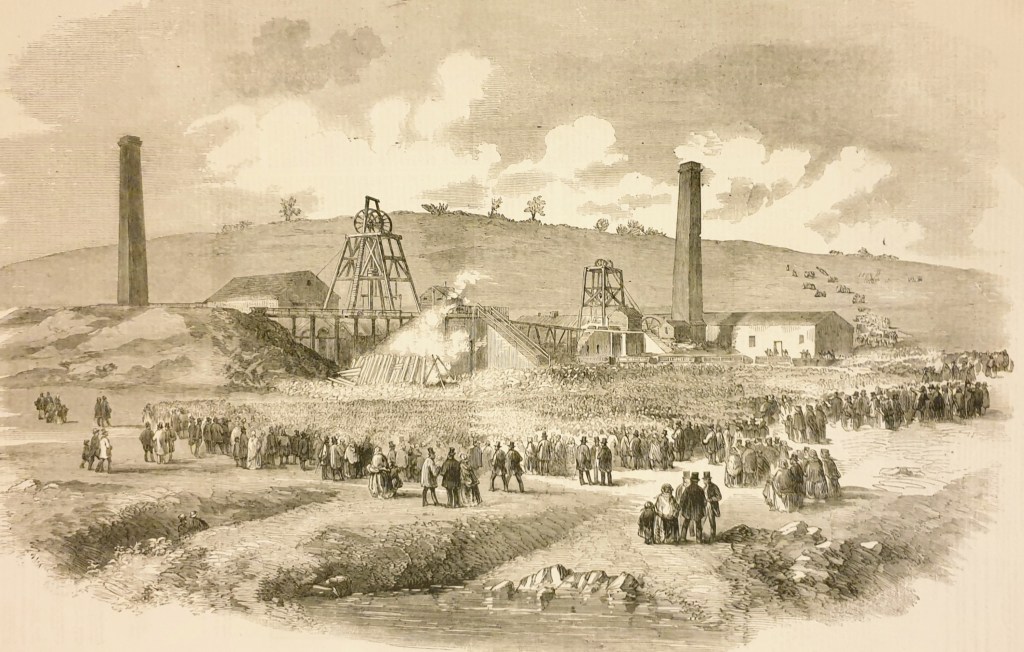
Engraved view of Lundhill (or Lund Hill) Colliery after the disaster, showing crowds assembled at the surface buildings (Illustrated London News, 28 February 1857, p.195)
On this day in 1857, a horrific underground explosion of firedamp occurred at Lundhill Colliery, between Wombwell and Hemingfield, claiming 189 lives, including 120 adults and 69 children.
Snippet from the Lundhill Colliery entry in Mines Inspector Charles Morton’s Report of the Working of the Coal Mines Inspection Act (18 & 19 Vict. c.108.) in Yorkshire, for the Year ending the 31st December 1857, HMSO, 1858, p.134
The impact on families in the community was catastrophic, leaving 90 widows and a total of 220 children without a father. We remember the victims and the devastating impact on the local community, and is a reminder of the serious dangers of working gaseous coal seams underground with the rules, practices and tools available at the time.
Hemingfield Colliery (also know as Elsecar Low pit) was working the same Barnsley seam, and employed the neighbours of Lundhill miners, so it was a community tragedy. Hemingfield Colliery itself had only too recently (Dec 1852) experienced its own loss of life via a underground explosion.
Flask bottle embossed with G. Steeples, Milton Arms, Hemingfield
The original contents of this particular whisky flask type glass bottle are unknown, although spirits seem more likely than the round bottles usually seen for beer. Starting with this object with a local provenance, and working with memories and records from Hemingfield families, this blog is an exploration of the changing times in the village, and a small contribution to sharing the stories of local people through to the present day, as part of The Friends of Hemingfield Colliery’s Hemingfield’s Hidden History project, supported by the National Lottery Heritage Fund. It’s thanks to National Lottery players that this history and heritage work can be developed and shared with the public.
In what we hope will be an ongoing series of guest blogs on the site, we’re delighted to share this Creative Heritage piece, sharing the story of one of many creative ways of engaging with heritage and history, inspired by or aligned with the stories of Hemingfield Colliery.
This one brings together old and new technology as Peter Duthie shares his insights into planning, designing and fabricating 3D models of industrial electric locomotives. Peter writes:
View of the winding engine house from the the pumping shaft level
On Saturday 17th October 2020, The Friends of Hemingfield Colliery squeezed another socially-distanced and Covid-safe session for a small number of volunteers. Working outdoors in the fresh air it was a busy day, even if it might have been the last in 2020.
View of lower terrace and top of retaining wall with repairs reaching the top.
Seizing another weekend of good weather and maintaining the momentum of recent weeks, the Friends and regular volunteers started early and quickly got shovelling, mixing and delivering lime mortar ready to continue rebuilding the collapsed rear retaining wall. Working safely outdoors and with focus to get the job done, the global pandemic seemed a little further away for a short while.
Another weekend, another day to catch up on some of the time lost from the initial impact of the Coronavirus pandemic. The Friends of Hemingfield Colliery have been operating on a much-reduced closed-site basis with pre-arranged and socially distanced activities being undertaken by the regular volunteers.
The weather had been touch and go in the week proceeding Saturday 29th August 2020, but the forecast suggested hopes of at least a decent morning’s worth of work without rain, leading us into a very different kind of August Bank Holiday weekend.
Compared to 2020, 2019 looked quite different, with no pandemic, and Open Days bringing visitors and volunteers through the gates at Hemingfield.








 Friends of Hemingfield Colliery