Leaping to Jump’s defence

Are you going to Jump?

Jump road sign

Jump, near Barnsley, in South Yorkshire is certainly an eye-catching name on a sign, and somewhat arresting when said out loud.

But locals have heard it all before…

“…you have a slight touch of onomaphobia as regards the name of our village. The name, tout court, certainly does impinge rather directly on the attention, showing that it has the “punch” or “pep” so beloved of our transatlantic cousins. By the way, the name of Jump would make the fortune of a striving burgh out West.”

Penistone, Stocksbridge and Hoyland Express, 4th April 1925, p.4

Wild West or not, in times gone by it has often been the subject of comment and even scandal:

“Jump was noted as the sport of the Press, and any sensational story was tacked onto it. Society at large thought of it with derision, and speculators gave it a wide berth.”

Barnsley Chronicle, 2nd March 1901, p.7
But where does the name come from?

Continue reading

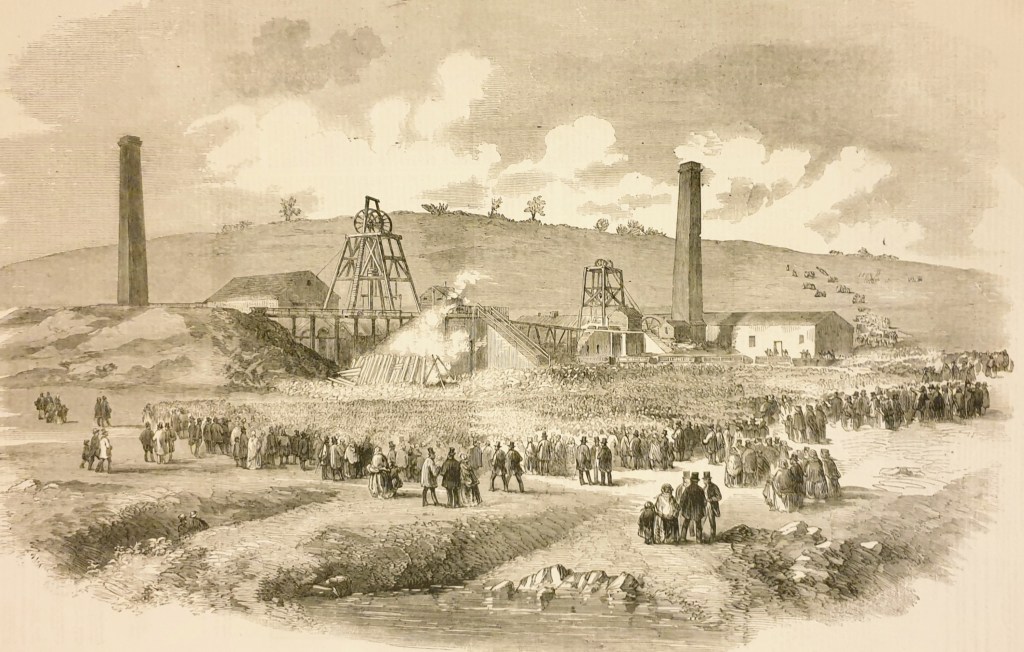
Lundhill Colliery Disaster, 19th February 1857

Engraved view of Lundhill (or Lund Hill) Colliery after the disaster, showing crowds assembled at the surface buildings (Illustrated London News, 28 February 1857, p.195)

On this day in 1857, a horrific underground explosion of firedamp occurred at Lundhill Colliery, between Wombwell and Hemingfield, claiming 189 lives, including 120 adults and 69 children.

Snippet from the Lundhill Colliery entry in Mines Inspector Charles Morton’s Report of the Working of the Coal Mines Inspection Act (18 & 19 Vict. c.108.) in Yorkshire, for the Year ending the 31st December 1857, HMSO, 1858, p.134

The impact on families in the community was catastrophic, leaving 90 widows and a total of 220 children without a father. We remember the victims and the devastating impact on the local community, and is a reminder of the serious dangers of working gaseous coal seams underground with the rules, practices and tools available at the time.

This commemorative piece is produced as part of the research underway for our Hemingfield’s Hidden History project, enabled by The National Lottery Heritage Fund, looking into the working lives and conditions in and around Hemingfield Colliery.

Hemingfield Colliery (also know as Elsecar Low pit) was working the same Barnsley seam, and employed the neighbours of Lundhill miners, so it was a community tragedy. Hemingfield Colliery itself had only too recently (Dec 1852) experienced its own loss of life via a underground explosion.

Continue reading

Message on a bottle

In a bottle, surely?

– Not quite.

Image of whisky flask type glass bottle embossed with G Steeples, Milton Arms, Hemingfield
Flask bottle embossed with G. Steeples, Milton Arms, Hemingfield

The original contents of this particular whisky flask type glass bottle are unknown, although spirits seem more likely than the round bottles usually seen for beer. Starting with this object with a local provenance, and working with memories and records from Hemingfield families, this blog is an exploration of the changing times in the village, and a small contribution to sharing the stories of local people through to the present day, as part of The Friends of Hemingfield Colliery’s Hemingfield’s Hidden History project, supported by the National Lottery Heritage Fund. It’s thanks to National Lottery players that this history and heritage work can be developed and shared with the public.

Made possible with National Lottery Heritage Fund support, thanks to National Lottery players.
Continue reading

Autumn falls; rising hope

view of a flowering yellow weed growing out of a sandstone wall with an engine house building above it. Hope in dark times.
View of the winding engine house from the the pumping shaft level

On Saturday 17th October 2020, The Friends of Hemingfield Colliery squeezed another socially-distanced and Covid-safe session for a small number of volunteers. Working outdoors in the fresh air it was a busy day, even if it might have been the last in 2020.

Continue reading

Flat out – volunteer work at Hemingfield

Chasing the clouds away. The main headgear at Hemingfield Colliery

Sun shine after the rain

After a week of, well let’s say ‘changeable’ weather, the Friends and regular core volunteers were keen to recoup some of the time lost to site maintenance since March and the beginning of the lockdown due to the COVID-19 pandemic. Because of this an extra Saturday when the weather looked set fair was seized on 11th July to continue the weeding, cleaning and tidying the site so that it is back in good order for what the future may bring as the world, or the UK at least, takes its first steps back towards a new normal.

Continue reading

On yer bike – back to the Bicycle Pit (safely)

Returning to a new normal: a view of the colliery on Saturday 4th July 2020

Back. Working behind closed gates, and observing social distancing and regular hand sanitising, the Friends of Hemingfield Colliery made a careful return to site.

View of the closed pit gates from inside the pit. Keeping volunteers safe as they tentatively start to return to site.
Volunteers working behind closed gates. Trying out the new requirements and taking steps towards more activity back on site.
Continue reading

In sickness and in health…

In a pandemic world, hidden away from each other, we have time to look at history’s lessons – to research some local history on Hemingfield and its people, the history and geography of their health over time. Just as today we experience challenges to increased mortality and public health, so too our ancestors struggled as modern healthcare developed and new treatments became available. The following is a brief piece of research supporting our Hemingfield’s Hidden Histories project, funded by the National Lottery Heritage Fund, thanks to National Lottery players.

Local Authority

At the end of the Nineteenth and beginning of the Twentieth Century, Hemingfield came under the local governance of Wombwell Urban District Council. The body oversaw most local services and reported on the health and welfare of the population, numbering an estimated 17,764 souls.

Detail of area from Ordnance Survey Quarter inch, Second Edition, 1914
Continue reading

From Pit to Pump: 100 years ago today, 15th May 1920

View of Hemingfield Colliery in May 2020: the 2 concrete headgears over the old winding pit and the pumping pit and the 2 engine houses can be seen
View of Hemingfield Colliery, May 2020

100 years ago…

A hundred years ago today, on the 15th May 1920, the last corf load of coal was raised from Earl Fitzwilliam’s Hemingfield Colliery. It marked the end of an era for the pit, as silence fell, albeit temporarily, at the main winding shaft.

Continue reading

Impact of COVID-19, Coronavirus Pandemic on currently planned FoHC events

The Friends of Hemingfield Colliery

Given recent Government announcements and based on the advice of Public Health England on the extraordinary steps needed to achieve effective social distancing and shielding vulnerable groups, the Friends have decided it would be prudent to temporarily close the site to the general public and so cancel publically advertised open days for the immediate future.

This will be regularly reviewed in line with the latest guidance.

Unfortunately this will likely delay some project activities planned for the year as part of Hemingfield’s Hidden Histories project, funded by the National Lottery Heritage Fund. However all remote/online activities will continue, and even possibly expand, with social media posts, Twitter, Facebook and website updates.

Please continue to get in touch to learn more about the site, its history, surviving built heritage and future plans.

Stay safe everyone!
The Friends of Hemingfield Colliery